Each case separates the question, observed evidence, interpretation and what still needs confirmation. Published examples retain their source results. Educational exercises are explicitly labelled and contain no real patient data.
CLL / Qualitative educational exercise / No patient data
Can a characteristic phenotype establish CLL?
A teaching request asks whether a CD19-positive, CD5 / CD23-coexpressing B-cell pattern with weak CD20 is sufficient to assign CLL. No absolute clonal B-cell count, duration, clinical examination or tissue assessment is supplied. What can you conclude?
Specimen and marker reasoning
This is a deliberately incomplete educational blood-work-up question, not a patient report. Establish mature B-cell identity and assess light chains, CD20, CD23, CD79b, CD43, CD81, CD200, CD10 and ROR1 in the appropriate differential.
Gating strategy
In a real specimen: review acquisition quality, singlets and viable leukocytes where measured; identify B cells broadly; assess co-expression, intensity and clonality; back-gate discordant populations. No gates or dot plots were fabricated for this exercise.
The teaching phenotype may support CLL, but the clinical category is unresolved. Obtain an absolute clonal B-cell count and clinical context. The iwCLL blood criterion generally uses at least 5 × 10^9/L clonal B cells sustained for three months; tissue disease and other relevant findings alter the interpretation.
What to look at next
Use the ERIC / ESCCA required and recommended diagnostic markers, then compare the published lymphoma-discordance example below. The private CLL dataset poster is not used here.
The source is an AML marrow follow-up example, not a new CFCM patient. The authors describe the red abnormal compartment as CD117 / HLA-DR-negative with reduced CD13, CD38 and CD371. The figure includes CD34, CD71 and CD19 views.
Gate logic
Review the whole abnormal pattern and back-gate it rather than requiring one expected antigen. Compare with diagnostic LAIP and different-from-normal patterns; consider regeneration and therapeutic antigen changes.
Differential and pitfalls
A suspicious island may represent disease, normal regeneration or an artifact. Corroborate identity across independent combinations and acquisition / specimen quality. These published plots do not provide raw-event access or independent CFCM gate validation.
Final interpretation
The source authors identify an abnormal AML compartment. CFCM’s lesson is to avoid a restrictive CD117 / HLA-DR assumption. No new percentage, diagnostic classification or quantification threshold is inferred from the image.
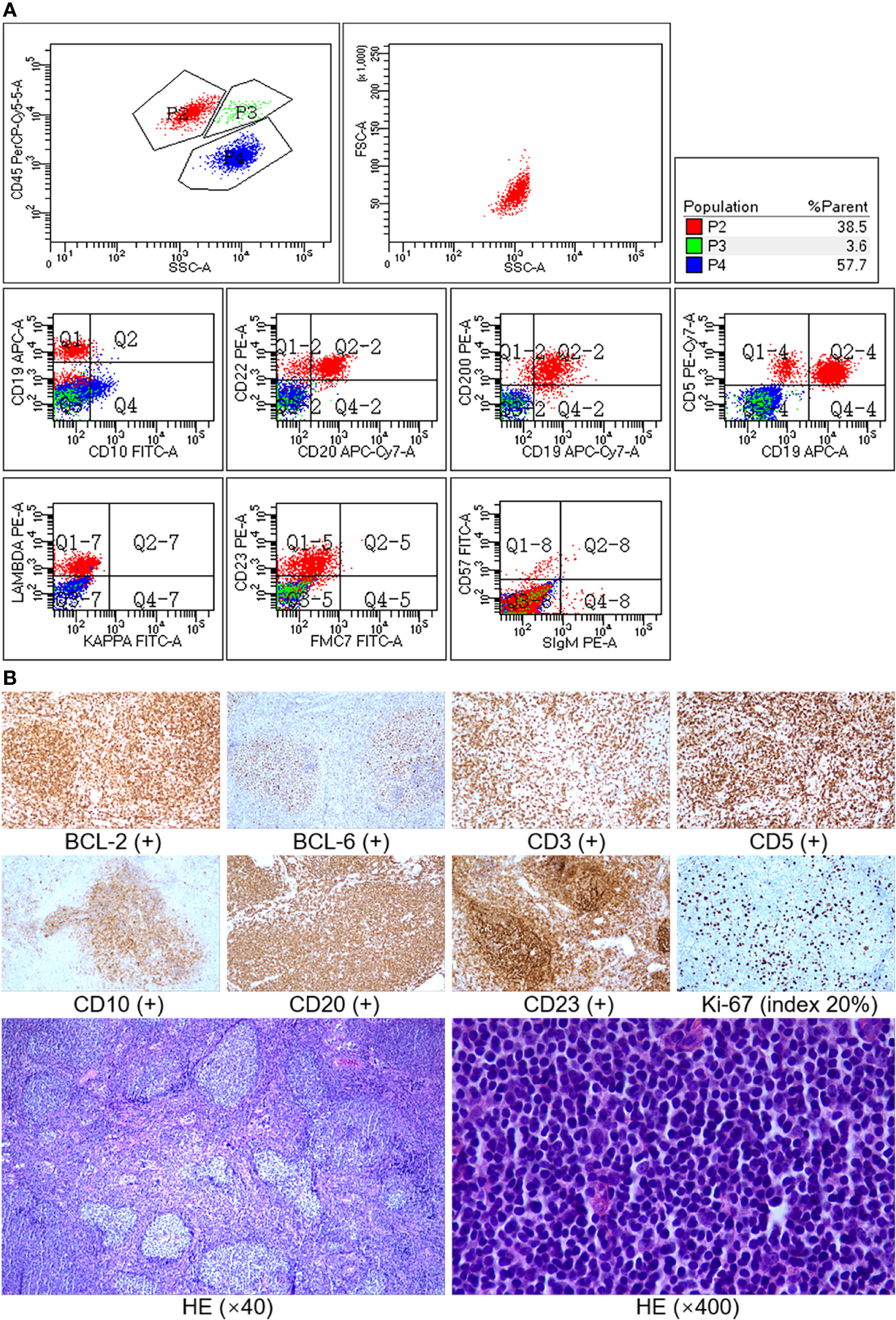
The report describes a marrow CD5 / CD23 / CD200-positive, CD10-negative mature B-cell pattern that initially supported CLL. Nodal assessment supported follicular lymphoma. The source’s light-chain / surface-Ig wording is not fully consistent; no new clonality result is inferred here.
Gating and visual interpretation
Panel A is the authors’ marrow analysis; raw FCS files are not supplied for CFCM reanalysis. Panel B shows nodal histology. CD3 / CD5-positive background T cells and CD23-positive follicular dendritic cells must not be interpreted as tumour-cell positivity.
Differential and next investigation
CLL / SLL, mantle cell lymphoma and a follicular lymphoma with compartment-dependent phenotype require integrated assessment. Resolve the node with architecture, morphology, immunohistochemistry and indicated genetics.
Final interpretation
In this published case, integrated nodal assessment established follicular lymphoma. The transferable lesson is diagnostic escalation when compartments disagree, not a new rule that every CLL-like phenotype is follicular lymphoma.
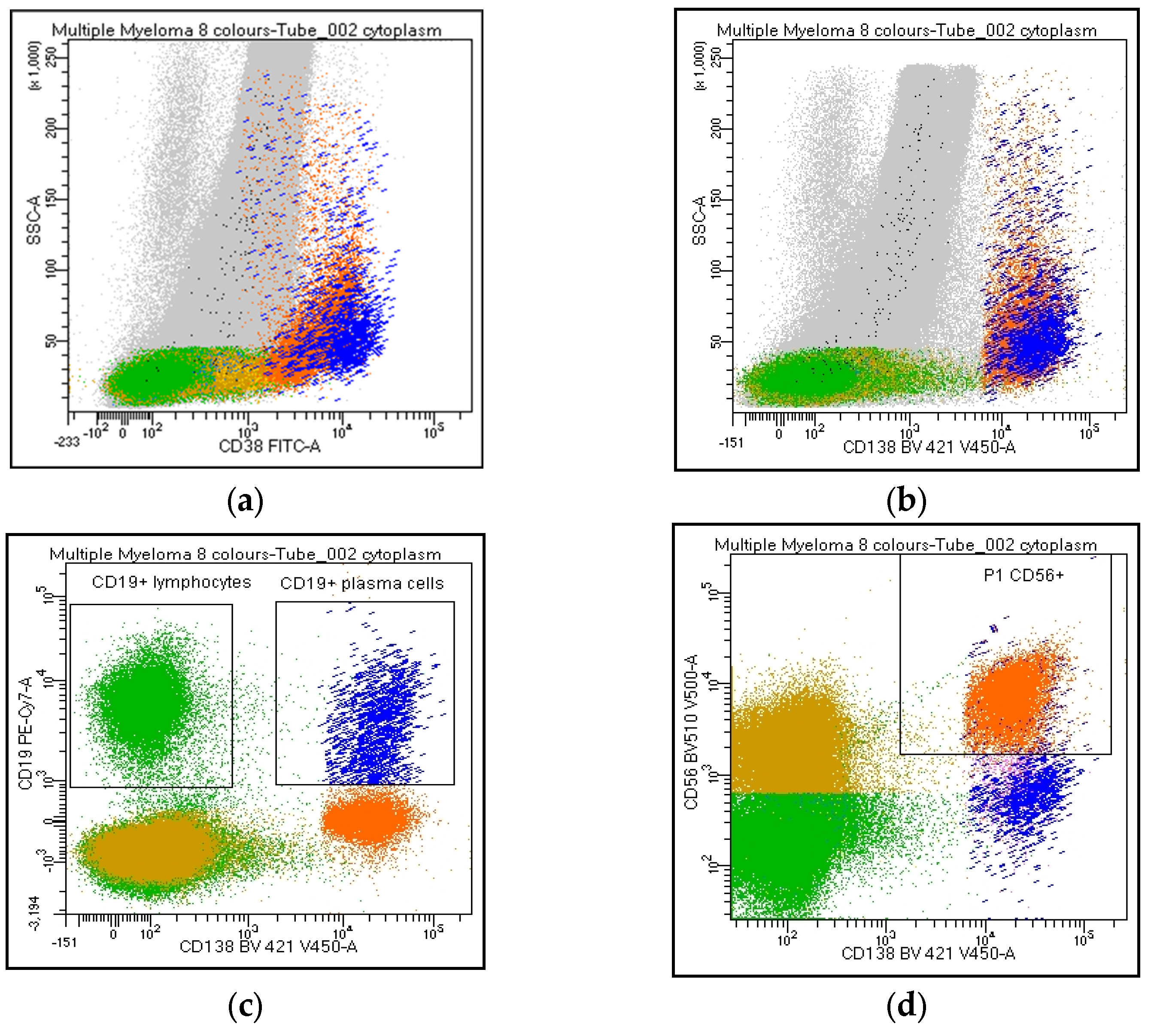
This published consensus illustration demonstrates marrow populations and plasma-cell identification. It is not a fully documented patient diagnosis. Its purpose is to interrogate identification and sample quality.
Markers and gate logic
Use CD38 / CD138 with CD45, scatter and independent phenotype markers. Do not exclude CD45-negative plasma cells or assume every clone remains bright for CD38 / CD138. Inspect cytoplasmic light chains in informative subpopulations with internal controls.
Differential and pitfalls
Normal plasma cells are heterogeneous. An aberrant surface marker alone does not establish a clone. Anti-CD38 therapy can interfere with identification; haemodilution, poor recovery and processing delay can undermine a negative MRD interpretation.
Final interpretation
Identify plasma cells multidimensionally, corroborate abnormal subsets and report the denominator. A clonal flow population supports the work-up but does not by itself assign the clinical category of myeloma.
MRD / Educational reporting exercise / No patient data
Detected does not necessarily mean quantifiable
A qualitative exercise stipulates that a coherent abnormal population meets the locally validated detection criteria, but its target count is at or below the assay’s validated quantification boundary. Which reporting category is justified?
Context and markers
No patient, event count, percentage or plot has been invented. The disease-specific assay must preserve cell identity, abnormality and normal comparators; there is no universal MRD tube.
Reasoning sequence
First establish coherent identity across the measured dimensions and exclude artifacts. Next apply detection criteria and background. Finally ask whether quantitative performance is supported for the actual informative denominator.
Final interpretation
Detected but not quantifiable is appropriate under the stated conditions. Do not call the finding quantifiable positive or supply an apparently precise percentage. If identity or detection is not supported, the exercise’s premise no longer applies.
What changes a negative report?
An insufficient denominator, compromised specimen, haemodilution or unreliable marker detection can limit the achieved sensitivity. Report those limits rather than treating every acquisition as a definitive negative.
Figures by Jum’ah et al., Ren et al. and Cordone et al. are reproduced with attribution under Creative Commons Attribution 4.0. Original data points, gates and labels are unchanged; display size is adjusted. Complete sources and captions are linked beside each figure.
Clinical reasoning library
Study published clinical examples and clearly labelled educational exercises. Each explanation states what the material can establish and what still needs confirmation.
Publication requires source traceability, accountable editorial review and appropriate data permissions. Independent scientific review will be identified only where it has actually occurred. The case library will not imply a weekly publication schedule before reviewed cases are available.