Velociraptor compares cell populations across cytometry platforms
Summary
Velociraptor compares cell populations across cytometry platforms. Research comparisons do not establish prospective clinical diagnostic validation.
Source Date
September 10, 2026
Source checked
Event Type
Peer-reviewed methods study
Event Date
September 10, 2026
Geography
Commercial Regulatory Status
Research method. This summary establishes neither clinical device authorisation nor commercial availability.
Related CFCM Topics
Technology Radar; cross-platform phenotype matching; research methods
Category
Technology
Primary source
Read the source →Facts supported by cited sources
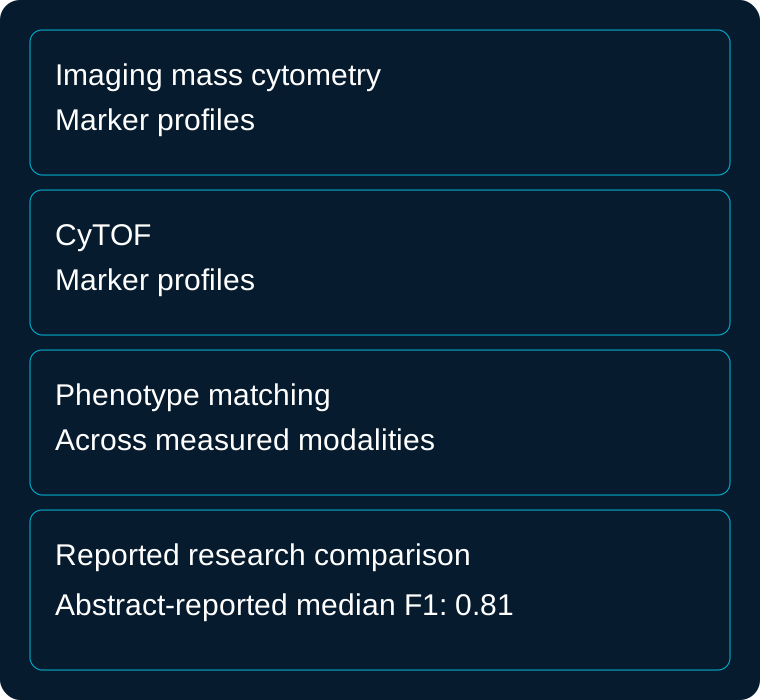
Cross CE, Brockman AA, Ihrie RA and Irish JM published Velociraptor Machine Learning Quantifies Similarity to Known Cell Types and Matches Cells Across Flow and Imaging Cytometry Platforms in Cytometry Part A on 10 September 2026, DOI 10.1002/cyto.a.70066. The abstract reports a median F1 of 0.81 for cross-platform immune-cell identification between IMC and CyTOF; performance varies by search direction and reference phenotype.
Reference
Cross CE, Brockman AA, Ihrie RA, Irish JM. Velociraptor Machine Learning Quantifies Similarity to Known Cell Types and Matches Cells Across Flow and Imaging Cytometry Platforms. Cytometry Part A. Published online 10 September 2026.
Read the original article — DOI 10.1002/cyto.a.70066 (new tab)
Claims Requiring Caution
This summary concerns a research comparison using shared measured marker features. It does not establish a diagnostic decision rule or a universal cross-platform performance guarantee.
Why It Matters
Matching phenotypes across modalities may support reuse of population annotations. Research comparisons do not establish prospective clinical diagnostic validation; an F1 measure is not a percentage of all cells correctly classified.
An announcement is not proof of availability or authorisation. Interpret status within the stated jurisdiction and evidence boundary.
Editor and independence disclosure →