When QC passes but cytometer stability changes: FlowCytoMonitoR
Summary
FlowCytoMonitoR brings historical instrument QC into a shared view. Its case studies support contextual troubleshooting, not a universal failure predictor.
Source Date
September 26, 2026
Source checked
October 20, 2026
Event Type
Peer-reviewed technical note / instrument QC software
Event Date
September 26, 2026
Geography
Commercial Regulatory Status
Published research software. Neither CE-IVD nor FDA authorisation for clinical diagnostic decisions is established. No product-launch or device regulatory milestone asserted.
Related CFCM Topics
Technology Radar; instrument QC; longitudinal trending; optical sensitivity; APD background; data harmonisation; CFCM Academy; Troubleshooting; Flow Cytometer Atlas.
Category
Technology
Primary source
Read the source →Facts supported by cited sources
Primary source: Britt Kolen, G. IJsbrand Reyneveld, Tom B. Kuipers, Marjolijn Hameetman, Hailiang Mei and Tamar Tak. FlowCytoMonitoR: An R-Shiny Program for Advanced Monitoring Flow Cytometer Performance. Cytometry Part A, first published 26 September 2026. DOI 10.1002/cyto.a.70065.
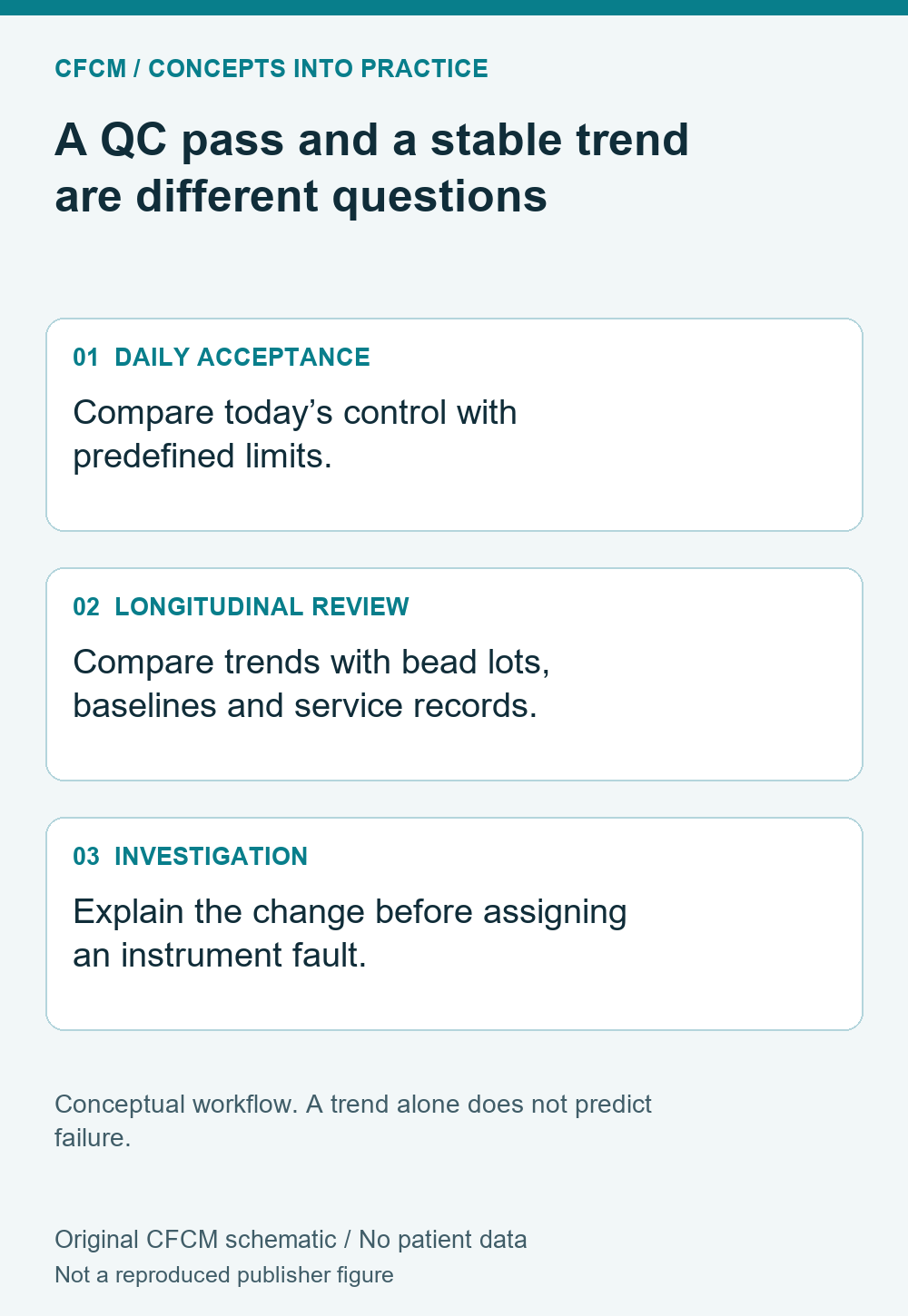
A green daily QC result is a useful acceptance decision. It is less informative about the direction of change across several months. The practical challenge is preserving both views without treating every trend as a fault.
What the technical note demonstrates
Kolen and colleagues describe an R-Shiny interface for historical QC records from BD Biosciences, Beckman Coulter and Cytek instruments. In one five-laser Aurora configuration, 414 metrics were recorded; 339 were outside the routine pass/fail assignment.
The paper's troubleshooting examples concern laser-related trends, detector background and service interventions. A similar pre-failure pattern appeared in two of seven local laser failures, but not in four additional failures assessed from external sites. That supports investigation of selected failure modes, not a generally validated failure predictor. Multi-vendor import likewise does not establish a common calibrated measurement scale.
Claims Requiring Caution
What a laboratory should preserve
Acceptance rules and investigation rules serve different purposes. Keep the manufacturer's daily QC decision visible. A trend-review process can add escalation criteria, but it should state who reviews a change, what contextual records are required and what action follows. A changing number alone should not be labelled a failed patient assay.
Comparability requires context. An instrument identifier, detector naming history, bead lot, QC baseline, software version and service record make a time series interpretable. A jump after a documented change and unexplained drift during a stable period deserve different investigations. Renaming or normalizing a field must preserve traceability to its original record.
Review the raw context as well as the cleaned display. A dashboard should make it easy to see when exclusions, axis choices or baseline resets alter the apparent pattern. A clean trend plot is helpful only if the laboratory can recover the events and settings that produced it. These are CFCM implementation questions, not additional performance claims for the software.
Why It Matters
Daily Learning Pill
Passing a test today and remaining stable over time are separate claims. Define the evidence needed for each, then document how an investigation changes the operational decision. More historical data can improve the investigation; it cannot, by itself, establish a validated alarm or a clinical performance claim.
Evidence and artwork: CFCM reviewed the publisher's methods, instrument table, case studies and limitations. The illustration is an original conceptual schematic. No Wiley figure or third-party image is reproduced, and no diagnostic regulatory authorisation is asserted.
An announcement is not proof of availability or authorisation. Interpret status within the stated jurisdiction and evidence boundary.
Editor and independence disclosure →CFCM WEEKLY · EVERY SUNDAY
The science behind the signal, in your inbox.
Get evidence-led clinical flow cytometry news, original conference posters, figures from published papers, practical learning pills, an advanced quiz and the story of one CD marker each week. Free. No spam.
Get CFCM Weekly →Complete the form and confirm the email we send you. Unsubscribe any time. Privacy policy.