CFCM Daily Radar — Synthetic Controls, EuroFlow AI, NK Clonality and CDx
Synthetic myeloma controls lead today’s CFCM radar, alongside decade-scale EuroFlow AML computation, tissue-aware NK clonality, Waters–CellCarta CDx strategy and ESCCA measurement uncertainty guidance.
Published 7 October 2026. CFCM editorial selection; peer-reviewed evidence, professional guidance and commercial sources are labelled separately.
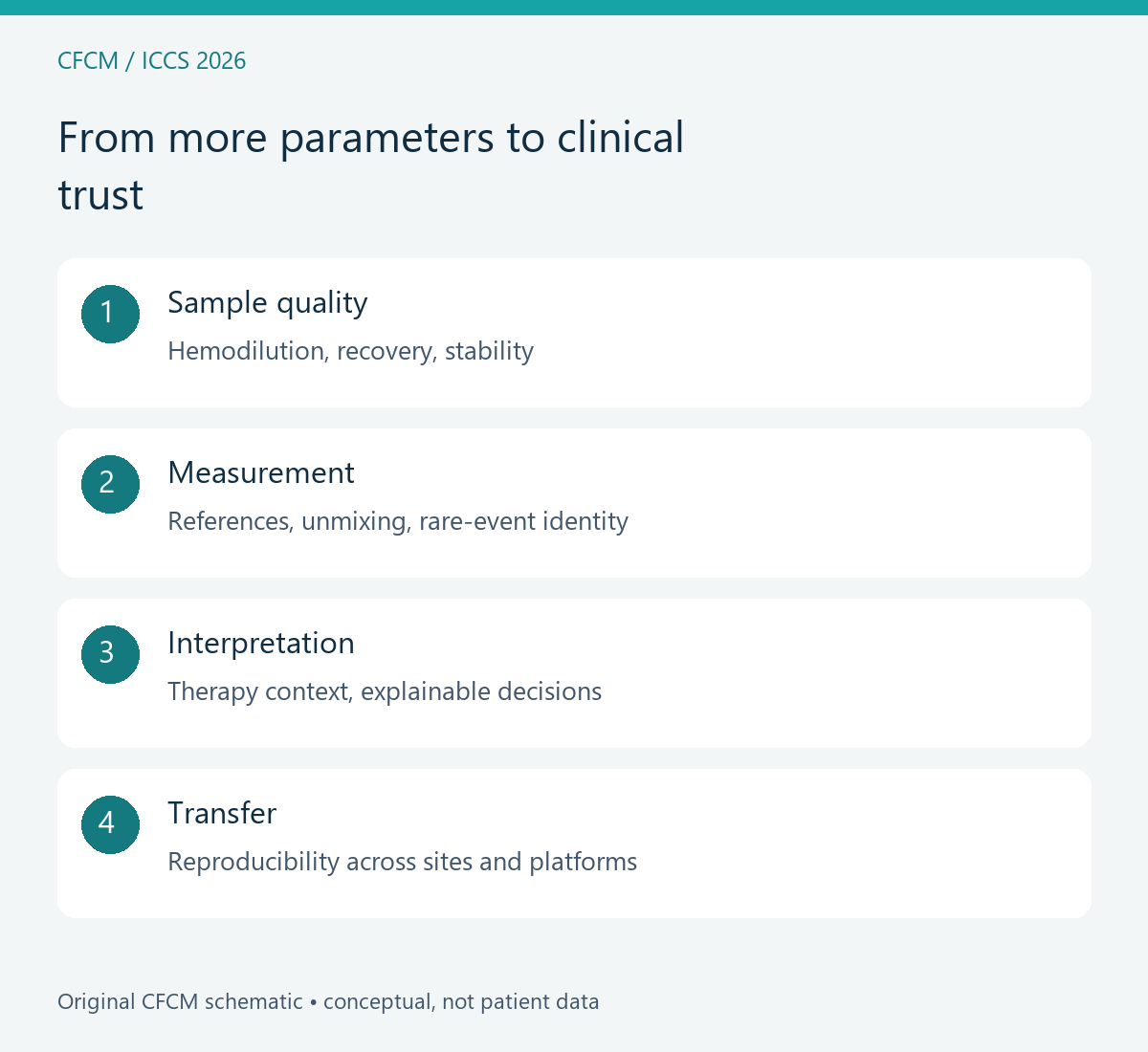
Paper of the Day — Synthetic cell mimics as assay controls in multiple myeloma
Peer-reviewed original research · Manufacturer-linked authorship (Bristol Myers Squibb and Slingshot Biosciences)
Dhong Hyun Lee, Mike Liu, Kanwal Palla, Subhanip Biswas, Swetha Pratyusha Gunturu and colleagues. Evaluation of a multiple myeloma synthetic cell mimic as an assay control for flow cytometry. Cytometry Part B: Clinical Cytometry. First published 5 October 2026. DOI: 10.1002/cyto.b.70075.
The authors engineered a two-population synthetic control intended to resemble both B cells and plasma cells. The design includes clinically relevant CD45, CD19, CD38, CD138, BCMA, GPRC5D, CD56 and PD-L1 expression and was developed to address limitations of MM.1S cells, which do not reproduce all of the gating and antigen-expression features encountered in marrow samples.
The study used a predefined ≤20% precision criterion and tested reconstituted material through day 7 at 4°C. The full results include exceptions: CD56 MFI changed by 26.56% on day 3; GPRC5D MFI had 21.51% inter-analyst CV and exceeded 20% at two accelerated-storage timepoints. The 13-month −20°C estimate comes from accelerated aging with Arrhenius translation, not 13 months of direct observation. These are assay-specific qualification results, not universal acceptance limits.
Why it matters to CFCM: assay controls are most valuable when they challenge the same analytical pathway used for the patient. A control that is stable but requires a different gating strategy may verify staining without verifying the clinical workflow that ultimately produces the result.
Daily Learning Pill — A control should challenge the same analytical path as the patient
A good clinical flow control is not simply a fluorescent object that produces the expected signal. It should reproduce enough of the specimen’s scatter, lineage-marker pattern, target-antigen density and negative populations to expose meaningful failures in staining, acquisition and analysis. This is closely related to commutability: the degree to which a control behaves like real patient material across the measurement process.
AI & Data — Ten years of standardized EuroFlow AML data become computationally reusable
Peer-reviewed original research
Sarah Bonte, Rosan Olsman, Sofie Van Gassen, Sergio Matarraz, Neus Villamor and colleagues. Old data, new tricks: Comprehensive computational analysis of 10 years of multi-center EuroFlow acute myeloid leukemia diagnostic immunophenotypic data. Cytometry Part B. First published 29 September 2026. DOI: 10.1002/cyto.b.70077.
The dataset contains 5,366 FCS files from 885 AML patients collected across eight centers over ten years using standardized EuroFlow ALOT and AML/MDS protocols. FlowSOM was used for population-level analysis. The model correctly predicted WHO 2008 genetic classes in 77% of cases and was tested in an independent validation cohort. That historical classification target should not be treated as validation against every current AML entity.
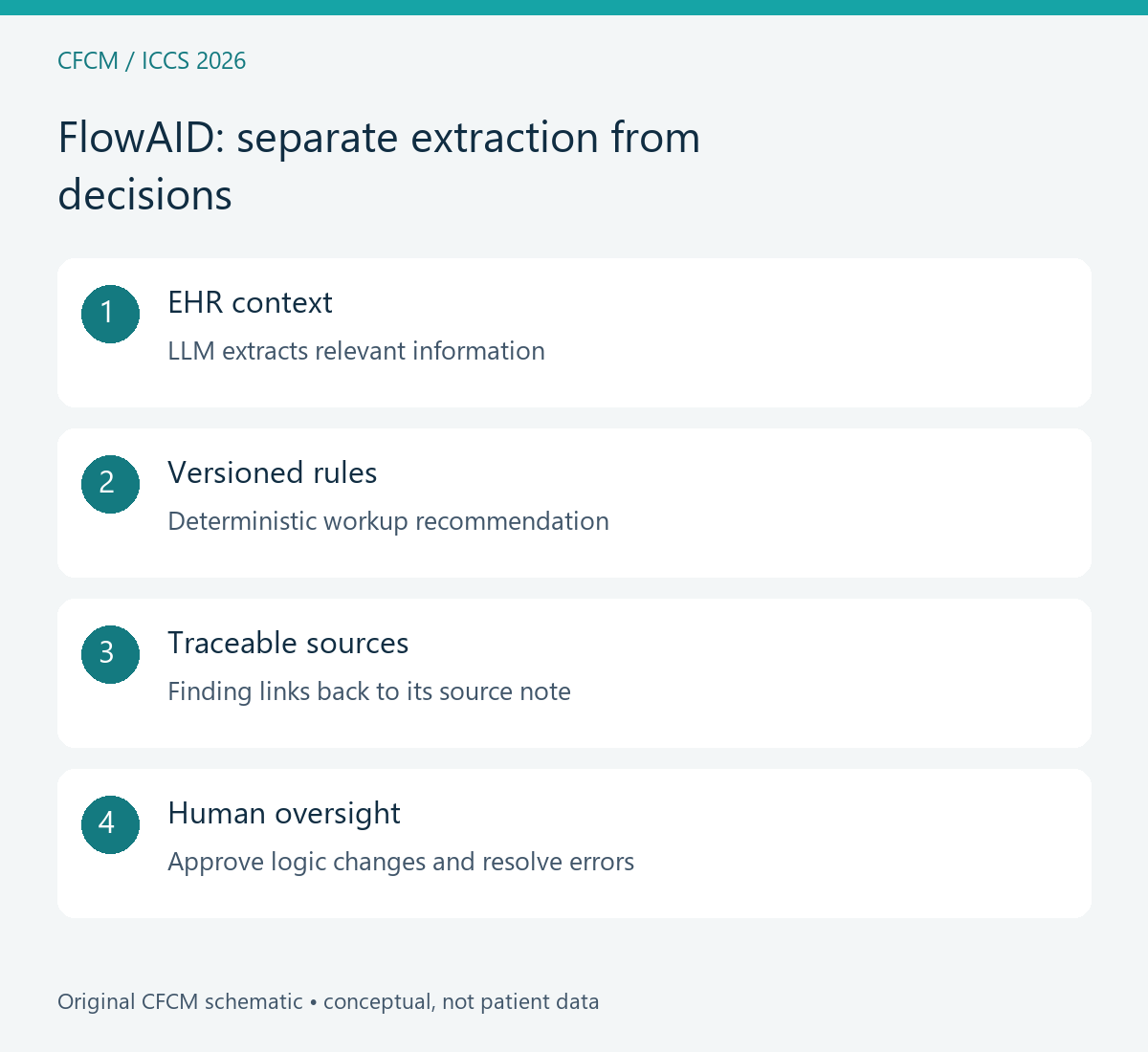
Why it matters to CFCM: the most important lesson is not the headline accuracy. Computational reuse at this scale became possible because acquisition and panels were standardized years before the machine-learning analysis. For clinical AI, data quality and interoperability are infrastructure, not preprocessing details.
Clinical interpretation — KIR restriction depends on NK subset and specimen type
Peer-reviewed original research
Valerie Woodings, Orrin Koepke, Jason E. Love, Alireza Torabi, Lianqun Qiu, Jonathan R. Fromm, Sindhu Cherian and Afshin Shameli. Subset-specific and tissue-specific expression of NK-cell markers and killer immunoglobulin-like receptors: Implications for NK-cell clonality assessment. Cytometry Part B. First published 1 October 2026. DOI: 10.1002/cyto.b.70078.
Across 120 specimens, the authors show that normal NK-cell composition differs materially by specimen. Peripheral blood and marrow are dominated by CD56dim cells, whereas lymph node and body fluids contain proportionally more CD56bright NK cells, with higher CD94/NKG2A and lower KIR expression.
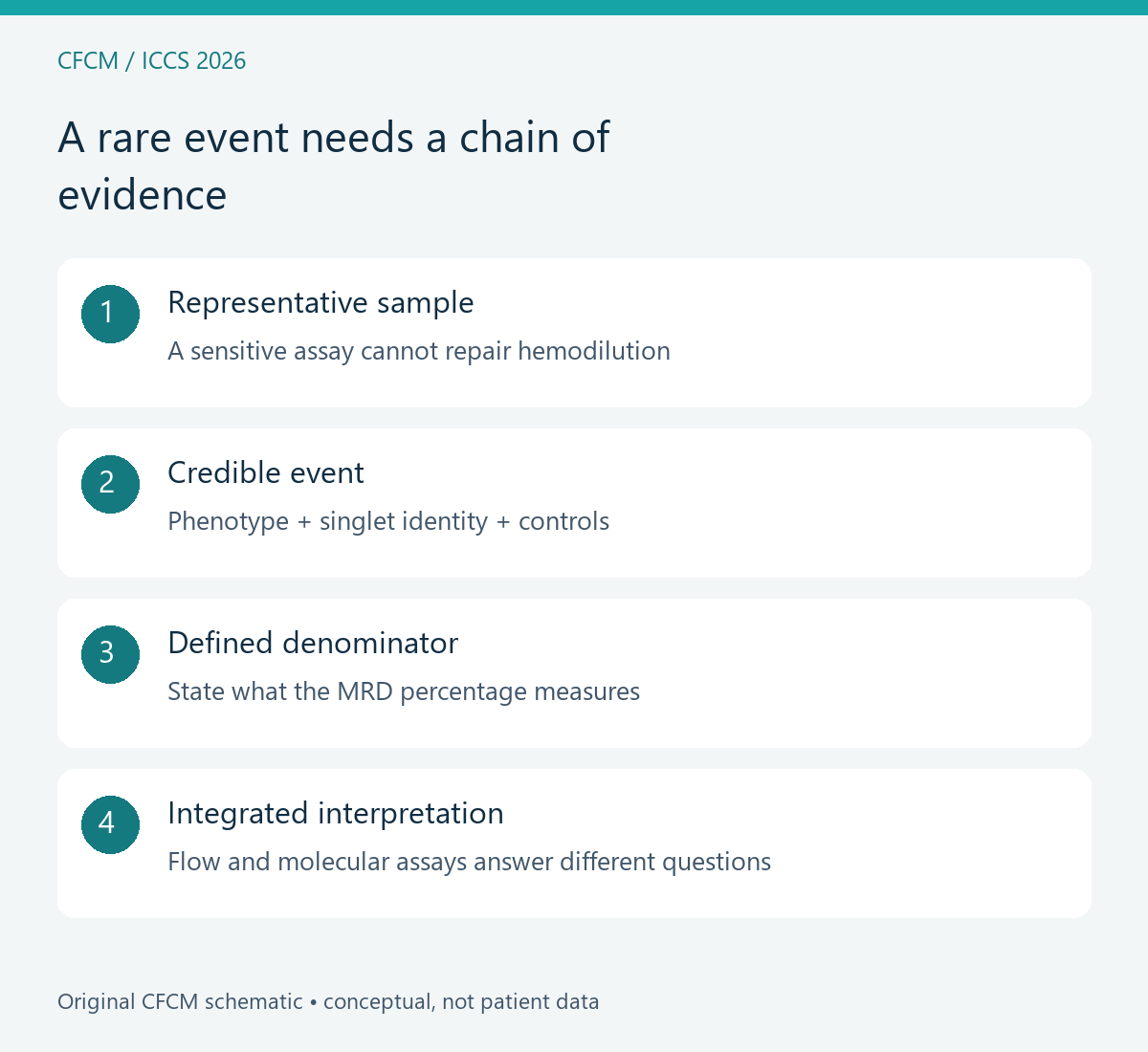
The practical diagnostic consequence is important: a KIR-negative phenotype is not automatically evidence of clonality. EBV-positive NK/T neoplasms may resemble the physiological CD56bright phenotype, while NK-LGLL more typically shows a mature CD56dim phenotype with restricted KIR.
Why it matters to CFCM: the correct reference population must match both tissue and NK subset before receptor restriction is interpreted as abnormal.
Company Watch — Waters and CellCarta move toward flow-cytometry companion diagnostics
Company/CRO announcement — not peer-reviewed evidence and not a regulatory approval
CellCarta's corporate webpage is dated 6 October 2026; its issuer-distributed PR Newswire release is dated 5 October. Both describe a partnership with Waters to pursue companion diagnostics and next-generation flow programs. The framework combines Waters technologies with CellCarta testing, validation and regulatory support; it does not identify an approved companion diagnostic.
No specific drug, approved companion diagnostic, clearance or authorization was announced. The significance is strategic rather than regulatory: the partnership places flow cytometry explicitly inside a drug-development and commercialization pathway.
Primary source:CellCarta — strategic partnership announcement, 6 October 2026.
Validation & Quality — ESCCA reframes measurement uncertainty as a risk problem
Peer-reviewed Best Practice / professional recommendations
Ulrika Johansson, Catarina Martins, Neil McIver-Brown, Eleni Linskens, Efthalia Yiannaki and colleagues. ESCCA recommendations for managing measurement uncertainty in ISO 15189 accredited flow cytometry laboratories: A risk-based approach. Cytometry Part B. First published 28 August 2026. DOI: 10.1002/cyto.b.70064.
The useful conceptual shift is that uncertainty in clinical flow is not reducible to a single instrument CV, particularly when the final result is qualitative or interpretive. ESCCA places specimen quality, preparation, reagents, gating, analyst interpretation and other sources of process variability inside a patient-focused risk framework consistent with ISO 15189:2022.
Why it matters to CFCM: this is directly reusable in Validation & Verification. Laboratories can identify which sources of uncertainty are capable of changing a clinically consequential result rather than performing numerical uncertainty calculations that do not reflect the actual assay.
No new regulatory decision specific to clinical flow cytometry met the threshold for inclusion in this scan. Regulatory Watch is therefore intentionally left empty rather than filled with low-value material.
Image and evidence note
The three illustrations are original CFCM explanatory graphics, not figures from the featured papers and not patient data. Scientific items link to their formal DOI; commercial developments are explicitly separated from peer-reviewed evidence.
About the author
Juan Manuel Ojeda — Founder & Editor, CFCMProfessional background includes Sysmex, Newcastle University and the NHS. CFCM is Juan Manuel Ojeda's independent editorial project and represents the author alone. Manufacturer references do not imply endorsement. Relevant professional or financial relationships are disclosed alongside the affected coverage.
Related: validation and analysis resources →Clinical Notes →Published 7 October 2026. Sources rechecked and qualification limitations clarified on 7 October 2026. CFCM source checking is not independent scientific review.