CFCM Daily Radar — CD24, CAR-T Resistance, Cytometry AI and ETP-ALL
CD24-directed immunotherapy leads the 13 October radar, alongside CytoDNNEnsemble, pediatric monocytic AML MRD and evolving ETP-ALL interpretation.
Published 13 October 2026. CFCM editorial selection; peer-reviewed evidence, reviews and translational limitations are labelled explicitly.
Paper of the Day — CD24 targeting after CD19 CAR-T resistance
Peer-reviewed original research
Qing Yin, Jing Gao, Xiangao Huang, Allen Hu, Rui Xiong and colleagues. Combating CD24 to overcome CD19 CAR-T resistance via induction of innate and adaptive immunity in B-cell malignancies. Leukemia. Published 12 October 2026. DOI: 10.1038/s41375-026-03159-y.
The study evaluates CD24-directed bispecific antibodies, CAR-T strategies and dual CD19/CD24 approaches in experimental B-cell malignancy models. CD24-directed activity persisted in models with CD19 antigen loss, and macrophage phagocytosis increased in functional experiments. These are preclinical findings, not evidence of clinical efficacy.
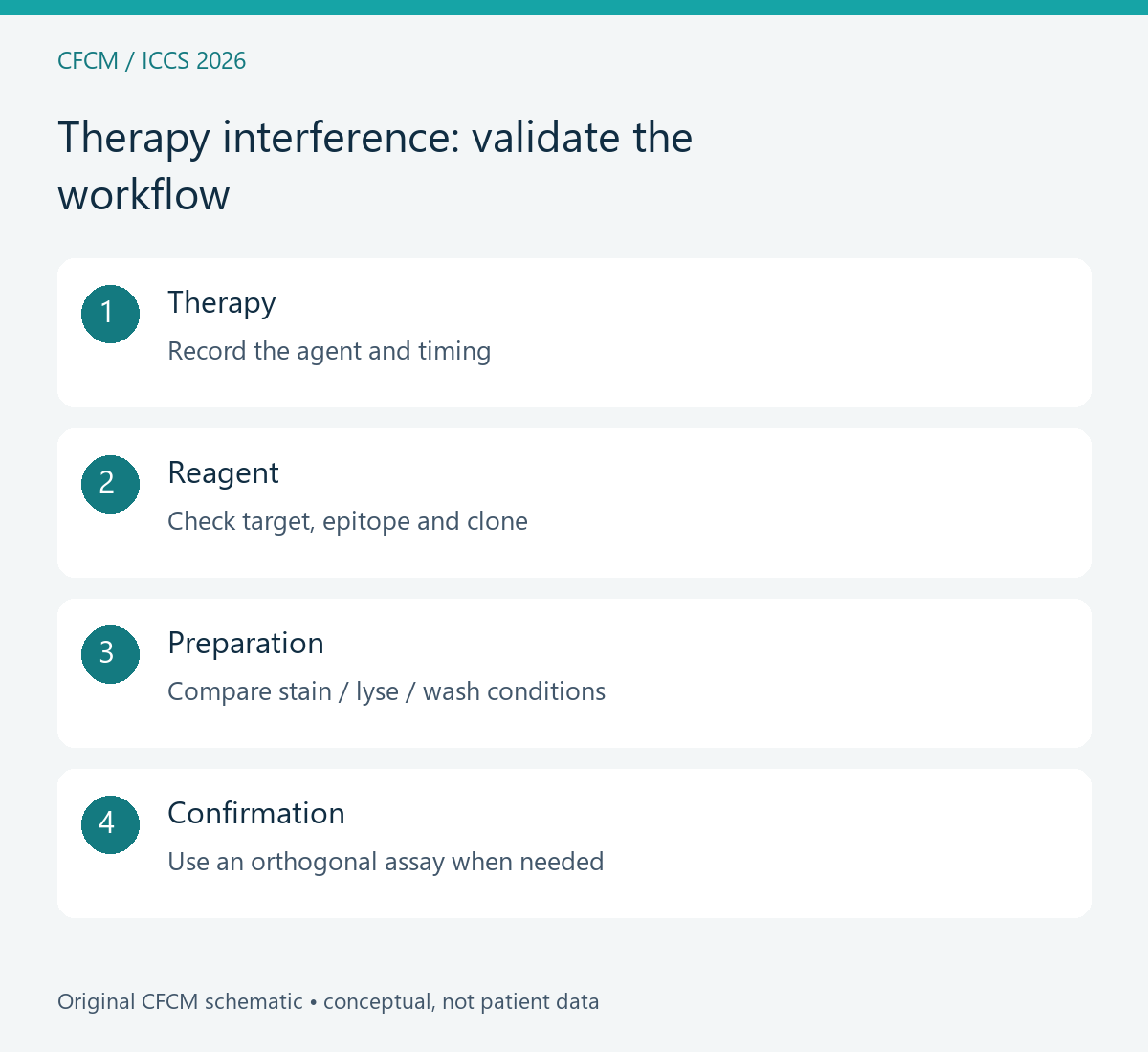
Why it matters to CFCM: target-antigen monitoring cannot stop at a single lineage marker. Antigen heterogeneity, escape after therapy and functional immune effects all affect how flow results should be interpreted.
Daily Learning Pill — “Don’t eat me” signalling and functional cytometry
CD24 can interact with Siglec-10 on macrophages and contribute to inhibitory phagocytic signalling. Detecting CD24 expression does not prove therapeutic suitability: density, heterogeneity, normal-cell expression and functional phagocytosis all matter.
Academy reuse: Functional Cytometry → Immune Evasion → Therapeutic Targets.
AI & Technology Radar — CytoDNNEnsemble
Peer-reviewed computational research
Tomasz Gniazdowski and Urszula Markowska-Kaczmar. CytoDNNEnsemble: combining cell-level and distribution-level representations for flow-cytometry classification. Scientific Reports. Published 12 October 2026. DOI: 10.1038/s41598-026-74128-9.
The architecture combines cell-level and sample-distribution representations. Performance improved on some public benchmarks but remained dataset-dependent. Benchmark classification accuracy is not equivalent to clinical validation or rare-event MRD performance.
CFCM placement: Intelligence → AI & Technology Radar; Academy → Automated Analysis.
Pediatric monocytic AML — MRD remains prognostically relevant
Peer-reviewed retrospective clinical research
Clinical Outcomes and Prognostic Factors in Pediatric Acute Myeloid Leukemia with Monocytic Differentiation: A Single-Center Cohort Study from Egypt. Frontiers in Oncology. DOI: 10.3389/fonc.2026.1969723.
MRD positivity after first induction was independently associated with poorer outcomes. For CFCM, the key teaching point is analytical: monocytic maturation can complicate abnormal-versus-regenerating population discrimination, so thresholds should never be transplanted between laboratories without validating the full assay context.
CFCM placement: News → AML; Academy → MRD and Monocytic Differentiation.
Academy — ETP-ALL phenotype does not define the whole biology
Peer-reviewed review article
Hee Young Ju. Understanding and clinical approach to early T-cell precursor acute lymphoblastic leukemia. Blood Research. Published 12 October 2026. DOI: 10.1007/s44313-026-00181-y.
The review emphasizes how an immature ETP immunophenotype remains clinically useful while failing to capture all molecular diversity. MRD response remains central to risk assessment.
CFCM placement: Academy → T-ALL / ETP-ALL; Resources → Haematological Malignancy Reviews.
Evidence note
The featured CD24 work is preclinical. CytoDNNEnsemble is an algorithmic evaluation, not a clinical deployment study. The pediatric AML findings are retrospective and the ETP-ALL item is a literature review.
About the author
Juan Manuel Ojeda — Founder & Editor, CFCMProfessional background includes Sysmex, Newcastle University and the NHS. CFCM is Juan Manuel Ojeda's independent editorial project and represents the author alone. Manufacturer references do not imply endorsement. Relevant professional or financial relationships are disclosed alongside the affected coverage.
Related: validation and analysis resources →Clinical Notes →Published 13 October 2026. CFCM source checking and editorial qualification are not independent scientific review.