Analysis
Clinical Flow
ICCS 2026: The Posters That Matter for Clinical Flow Cytometry
From MRD and spectral QC to auditable AI and molecular flow: the ICCS 2026 signals that matter for trustworthy, transportable clinical information.
ICCS 2026 is not primarily a “more colors” story. Its most consequential transition is from measuring more parameters to making high-dimensional clinical information trustworthy and transportable. A single tube, an AI-assisted workup or a molecular signal matters clinically only when the laboratory can explain what was measured, recognize failure and reproduce the result.
This feature follows the meeting in Miami and online, October 4–6, 2026, with a clinically focused inventory of posters and technology signals. It separates the investigators’ preliminary reports from CFCM’s interpretation and the questions that remain.

How to read the evidence
- Conference Poster/Abstract: preliminary conference evidence; a presentation title is not proof of performance.
- Peer-Reviewed Support: separately identified published background. It does not validate the new conference dataset.
- Manufacturer-Linked Evidence: industry authorship, sponsorship or manufacturer-hosted material. This label can coexist with conference evidence.
- Work in Progress: a prototype, planned validation or incomplete results. No positive outcome is assumed.
Poster numbers refer to the official meeting program. Where an item is listed only on a manufacturer’s event page, it is described as a technology signal without an invented poster number. The clinical questions below are editorial interpretation, not instructions to change a patient’s management.
Explore the six clinical themes
- MRD and rare events: sensitivity needs trustworthy sampling.
- Spectral and high-dimensional flow: consolidation needs sustainable controls.
- AI and automation: reproducibility needs auditable decisions.
- Troubleshooting and therapy interference: the workflow is part of the assay.
- Validation, QC and preanalytics: transfer needs evidence beyond correlation.
- Molecular flow: distinguish molecular products from cellular phenotypes.
01 / MRD and rare events
The practical prize is a credible low-frequency population, with an explicit denominator and a representative specimen. High dimensionality offers more ways to identify it, but also more opportunities to misinterpret background.
#245 · Single-tube 39-parameter pediatric T-ALL MRD
Conference Poster/Abstract
Stacie Woolard and colleagues · St. Jude / MSK
The assay brings broad antigen assessment into one tube. The conference report describes comparison with the existing conventional assay and a structured review strategy, rather than asking reviewers to inspect every possible marker pair. CFCM considers this a priority for clinical follow-up.
What to watch next: Request the complete paired dataset, low-level precision, event requirements and examples from regenerative or therapy-altered marrow. Does the review strategy preserve detection of unexpected phenotypes? Source
#219 · Four tubes to one: blinded 20-color AML evaluation
Conference Poster/Abstract · Manufacturer-Linked Evidence
Paul Wallace and colleagues · Roswell Park / SciGro
The double-blinded design makes this more informative than a simple demonstration of a larger panel. Consolidation could preserve scarce material while retaining diagnostic relationships within the same cells. Cytek provided the panel and financial support; the abstract discloses an advisory-board relationship.
What to watch next: Review agreement and discordant cases, not just correlation or headline accuracy. Confirm which conclusions concern diagnosis and which support MRD. Source
#136 · NGS-positive / flow-negative is an interpretation problem
Conference Poster/Abstract
Tanvi Verma and colleagues · University of Washington
The important message is that discordance does not automatically establish residual disease. The identity of the molecular clone and the accompanying clinical and morphologic findings matter. Equally, negative flow does not automatically invalidate a positive molecular result.
What to watch next: Match the molecular target to the original disease, assess sampling and assay sensitivity, and examine possible unrelated clones before assigning biological meaning. Source
#216 · Hemodilution and discordant myeloid blast estimates
Conference Poster/Abstract
Ntasha Roy, Jerry Radich, Min Fang, Xiaoyu Qu, Cecilia Yeung, Shahanawaz Jiwani, Megan Othus, Harry Erba, Mark Litzow, Lyndsay Harris, Richard F. Little and Brent Wood.
Children’s Hospital Los Angeles / University of Southern California; Fred Hutchinson Cancer Research Center; National Cancer Institute / NIH; Duke University; Mayo Clinic; Moffitt Cancer Center.
View full poster (PDF) · Open high-resolution poster image. The PDF was exported from the original PowerPoint file shared by Ntasha Roy.
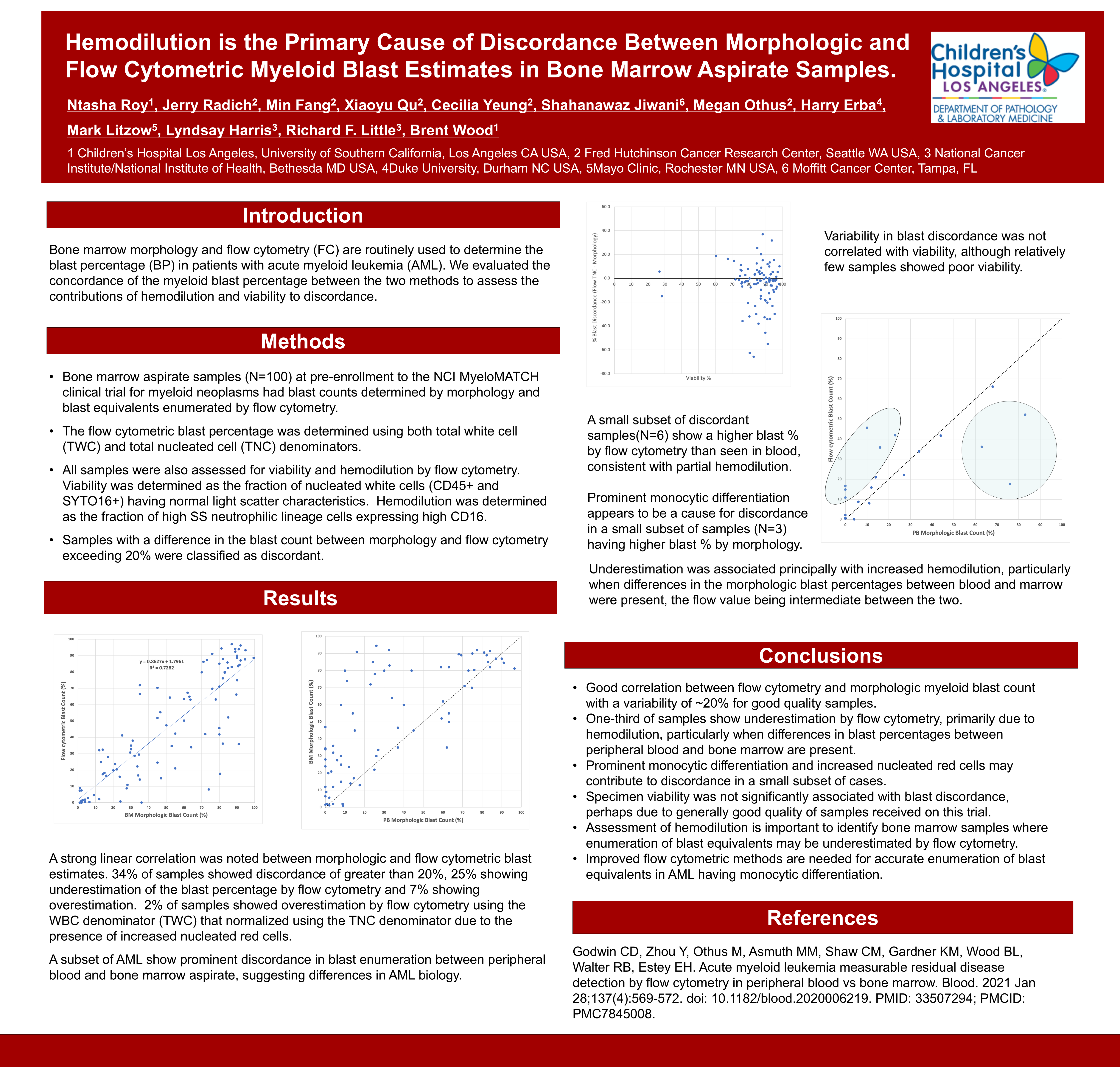
Study and methods: The investigators evaluated 100 pre-enrollment bone marrow aspirates from the NCI MyeloMATCH trial, comparing morphologic blast counts with blast equivalents enumerated by flow cytometry. Flow blast percentages used both total white cell (TWC) and total nucleated cell (TNC) denominators. A difference exceeding 20% between morphology and flow defined discordance. Hemodilution was assessed as the fraction of high-side-scatter neutrophilic-lineage cells expressing high CD16; viability was assessed among CD45+ / SYTO16+ nucleated white cells with normal light scatter.
Results: Despite a strong linear correlation, 34% of samples had greater than 20% discordance: 25% showed underestimation by flow and 7% overestimation. A further 2% showed apparent overestimation with the TWC denominator that normalized with TNC because of increased nucleated red cells. These categories account for the reported 34% discordance.
Underestimation was principally associated with hemodilution, particularly when peripheral blood (PB) and bone marrow (BM) morphologic blast percentages differed; flow estimates were intermediate between the two. In a subset of discordant samples (N=6), flow blast percentages exceeded those in blood, consistent with partial hemodilution. Prominent monocytic differentiation contributed to discordance in a small subset (N=3) with higher blast percentages by morphology. Viability was not significantly associated with discordance in this generally good-quality cohort, which included relatively few poor-viability samples.
Authors’ conclusion: Assessment of hemodilution is important to identify marrow samples in which flow may underestimate blast equivalents. Improved flow cytometric methods are needed for accurate blast-equivalent enumeration in AML with monocytic differentiation.
CFCM interpretation / what to watch next: Review specimen representativeness, PB/BM findings and the denominator before interpreting morphology–flow disagreement. These preliminary conference observations support attention to hemodilution and monocytic differentiation; they do not establish causality beyond this dataset or universal performance thresholds. The absence of a viability association in this cohort does not exclude an effect in poorer-quality specimens. Source: full conference poster
#133 · Imaging the rare abnormal plasma-cell event
Conference Poster/Abstract · Manufacturer-Linked Evidence
Siobhan Cashman and colleagues · Waters Biosciences
Integrated imaging provides a way to check whether a suspicious flow event has a credible single-cell origin. This is orthogonal evidence for event identity, not a substitute for validated phenotype-based MRD detection.
What to watch next: Ask for blinded adjudication, low-count false-positive studies and evidence that imaging resolves consequential artefacts. Source
#233 · cyTRBC1/2: useful, but only when informative
Conference Poster/Abstract
Valerie Woodings and colleagues · University of Washington
The conference abstract reports 20 T-LL/T-ALL cases: 12/20 were double-negative and therefore non-informative for this clonality readout; 8/20 were informative. In mature monotypic T-cell processes, 20/23 showed monotypic cytoplasmic TRBC1/2. The 23 include processes beyond unequivocal lymphoma, so that fraction is not a general diagnostic sensitivity.
What to watch next: Establish baseline expression and combine cytoplasmic TRBC with lineage, maturation and aberrancy markers. Double negativity cannot exclude T-LL or residual disease. Source
02 / Spectral and high-dimensional clinical flow
The strongest high-parameter story is an operational one: conserve material, preserve interpretable relationships and keep the reference system stable over time.

#103 · 29 colors / 31 antigens for integrated lymphoma evaluation
Conference Poster/Abstract
Sary El Daker and colleagues · MSK
A single-tube B-, T- and Hodgkin lymphoma workup is an ambitious consolidation target. The scope is clinically attractive, but the assay’s title alone does not establish disease-specific detection or performance in low-cellularity specimens.
What to watch next: Request diagnosis-stratified validation, recovery, failure rates and safeguards for rare Hodgkin-associated populations. Source
#128 · 58-parameter clinical diagnostic application
Conference Poster/Abstract · Manufacturer-Linked Evidence
Evangelia Williams and colleagues · IMU Biosciences
The breadth of the panel is a technology signal. It should be judged by how it resolves clinical decisions and how consistently the workflow handles heterogeneous specimen backgrounds.
What to watch next: Identify the actual clinical use cases, comparator assays, review burden and transferable acceptance criteria. Source
#102 · Multiple autofluorescence signatures with NMF
Conference Poster/Abstract
Dustin DeMeo and colleagues · Stanford
Non-negative matrix factorization addresses the possibility that a specimen contains more than one autofluorescence signature. Its practical relevance is strongest when background differs between biological populations.
What to watch next: Test robustness on low-cellularity samples and abnormal populations. Determine how the method avoids absorbing genuine marker signal into background components. Source
#244 · The day-to-day reality of clinical spectral QC
Conference Poster/Abstract
Uyen Pham and colleagues · Cedars-Sinai
The conference abstract describes lot/shipment spectral comparison with Similarity Index >0.97, tandem baselines with reassessment, a composite peripheral-blood/bone-marrow autofluorescence reference and NxN review for unmixing drift. These are local implementation procedures, not universal acceptance thresholds. A composite reference may poorly match tissue or CSF backgrounds.
What to watch next: Define local reference eligibility, change control and actions for drift. Recheck the effect on clinically decisive dim populations before accepting matrix adjustments. Source
#146 · Detector Setting Independent scaling
Conference Poster/Abstract · Manufacturer-Linked Evidence
Joshua Welsh and colleagues · Waters Biosciences
DSI scaling on FACSDiscover A7 targets a measurement problem: how to make signal interpretation more portable across detector settings. Scaling should be evaluated separately from biological and specimen equivalence.
What to watch next: Ask whether dim-signal resolution, saturation behavior and clinical classification are preserved across the intended settings. Source
#240 · Cross-platform spectral reproducibility
Conference Poster/Abstract · Manufacturer-Linked Evidence
Waters Biosciences
The manufacturer lists a comparison against FACSLyric. Its description of a “gold standard” is a sponsor framing; clinical laboratories still need an appropriate validated comparator for the intended assay.
What to watch next: Require agreement and bias across clinically relevant populations, plus an explanation of platform-specific failures. Source
03 / AI and automation
These projects address different tasks: specimen triage, cleanup, population recognition, reporting and physical preparation. They should not be presented as interchangeable forms of automated diagnosis.

#228 · FlowSimon across panels and platforms
Conference Poster/Abstract · Manufacturer-Linked Evidence
Kamraan Gill and collaborators · Zynasat / diagnostic laboratories
The cross-panel and cross-platform ambition makes FlowSimon a priority. A tool that works beyond a single fixed assay could be operationally important, but the conference evidence remains preliminary. Developer-linked authorship warrants a commercial-interest label alongside the collaborating laboratories.
What to watch next: Seek external prospective testing, failure-mode analysis and performance on low-level or unusual clones. Clarify the boundary between decision support and final sign-out. Source
#242 · Auditable ML with specimen-adaptive cleanup
Conference Poster/Abstract
Shreya Nagesh and colleagues · Cedars-Sinai
Cleanup is a consequential analytical decision. A specimen-adaptive workflow should expose what was removed and why, and permit reviewer inspection of the original data.
What to watch next: Evaluate pathological populations, fragile cells and rejected events. Monitor whether cleanup errors systematically change reported subset counts. Source
#243 · Beyond the frozen algorithm
Conference Poster/Abstract
Georgios Paterakis and colleagues · Athens / Flowdiagnosis
The human–algorithm–LLM framework for AML MRD raises a useful design question: how can a system improve while preserving an auditable and reproducible record of each decision?
What to watch next: Require version boundaries, locked validation sets, traceable human interventions and revalidation after changes. Treat explanatory fluency separately from analytical correctness. Source
#236 · FlowAID: context extraction, then deterministic rules
Conference Poster/Abstract · Work in Progress
Sulov Chalise and colleagues · MSK
A PHI-safe LLM extracts EHR context; a separate deterministic engine applies versioned rules to recommend a flow workup. The design links findings to source notes and requires human approval for logic changes. Validation on more than 1,000 specimens was announced, but the abstract does not publish the final performance results.
What to watch next: Request extraction-error rates, incorrect-workup rates and correction workload, including unusual histories and incomplete records. The stated privacy design also needs local implementation assessment. Source
#142 · Label-free foundation model for imaging-flow assays
Conference Poster/Abstract · Manufacturer-Linked Evidence
Keegan Owsley and colleagues · Waters Biosciences
Viability and functional assessment from imaging features is distinct from lineage or clonality classification. The appeal is information without adding a stain; the risk is a model that learns sample- or instrument-specific proxies.
What to watch next: Test distribution shift, calibration and biologically relevant failure cases against suitable reference measurements. Source
#145 · Automated tissue dissociation
Conference Poster/Abstract
Helena Varela de Araujo and colleagues · BIDMC
Automation should be assessed for viable cell recovery and preservation of diagnostic populations, not merely throughput. Tissue type, specimen size and processing conditions can change the populations that reach the cytometer.
What to watch next: Compare paired recovery and antigen preservation, then monitor diagnostic yield after implementation. Examine whether fragile populations are selectively lost. Source
#209 · Automated antibody cocktailing
Conference Poster/Abstract · Manufacturer-Linked Evidence
Melvin Lye and colleagues · Curiox / Stanford
The conference project addresses operator- and site-dependent preparation variability. This is manufacturer-linked evidence, even with academic collaboration. Standardized dispensing is only one part of an assay’s total variability.
What to watch next: Ask for multisite reproducibility, reagent omission detection, carryover, dead-volume effects and exception handling. Source
#134 · CellMek SPS automated dry-tube workflow
Conference Poster/Abstract · Manufacturer-Linked Evidence
Xizi Dai and colleagues · Beckman Coulter Life Sciences
Dry-tube preparation could simplify routine reagent handling. Manufacturer-linked conference comparisons need to be interpreted within the tested panel and preparation sequence.
What to watch next: Verify recovery, bias and carryover in the local workload, including uncommon or low-frequency populations and interrupted runs. Source
04 / Troubleshooting and therapy interference
Therapeutic exposure changes the interpretation of a signal. The relevant unit of validation is the therapy–reagent–preparation workflow, not a clone name in isolation.

#202 · Odronextamab: the wash step matters
Conference Poster/Abstract
Tori Catey and colleagues · University of Washington
The same anti-CD3 clone, UCHT1, behaved poorly in the AQUIOS stain/lyse/no-wash workflow but separated CD3-positive cells cleanly after a lyse/wash preparation on the orthogonal platform. This argues against reducing the problem to clone or epitope selection alone. The observation concerns a specific therapy and workflow.
What to watch next: Record odronextamab exposure and validate a suitable alternative preparation/assay. Do not export the reported solution to every CD3-directed therapy without testing. Source
Manufacturer-listed · Anti-CD38 VHH conjugates after targeted therapy
Conference Poster/Abstract · Manufacturer-Linked Evidence
Beckman Coulter Life Sciences
The clinical question is whether an alternative binding reagent remains informative after CD38-directed treatment. Performance depends on the therapeutic agent, accessible epitope, detection reagent and preparation. “VHH” alone is not a guarantee of interference resistance.
What to watch next: Request therapy-specific interference studies and compare redundant plasma-cell identification strategies. Source
#129 · Cytoplasmic κ/λ as a redundant plasma-cell strategy
Conference Poster/Abstract
Karthik Bommannan Kuppuraju and Shirley Sundersingh · Cancer Institute (W.I.A)
Cytoplasmic light chains offer an alternative identification route when CD38 is unreliable. A backup strategy should be evaluated for populations with weak or absent light-chain expression, rather than assuming all plasma cells will be captured.
What to watch next: Check agreement and missed populations in treated specimens. Preserve additional lineage and aberrancy markers. Source
#217 · GATA2 deficiency and a false PNH-like pattern
Conference Poster/Abstract
Fatima Sattar and colleagues
The conference report highlights GPI-deficient or PNH-like populations confined to one lineage. Cross-lineage coherence and the underlying marrow-failure context are central to interpretation. An isolated unusual population should trigger investigation rather than an automatic PNH label.
What to watch next: Confirm lineage definition, gating and reagent performance; integrate other lineages and clinical/genetic findings. Do not use cross-lineage discordance alone as a universal exclusion rule. Source
#234 · T-cell clonality plus TFH immunophenotyping
Conference Poster/Abstract
Valerie Woodings and colleagues · University of Washington
Combining clonality and TFH markers helps connect an abnormal population to its phenotype. TFH-associated marker expression and a clonal population each require context; neither independently establishes a specific lymphoma diagnosis.
What to watch next: Assess marker combinations and background reactive populations alongside tissue, morphology and the full clinical picture. Source
#215 · TRBC1/TRBC2 reagent development
Conference Poster/Abstract · Manufacturer-Linked Evidence
Beckman Coulter Life Sciences
Dual-reagent development supports assessment of both sides of the αβ T-cell repertoire. Product-associated conference evidence should remain distinct from independent disease-specific validation.
What to watch next: Check clone/conjugate performance, surface versus cytoplasmic protocols and local reference patterns. Interpret small clones in clinical context. Source
05 / Validation, QC and preanalytics
A reproducible control is useful only if it challenges the failure mode that matters. Transfer studies need clinically relevant agreement, while stabilization studies must preserve the rare population of interest.
#218 · Marrow stabilization for spectral AML MRD
Conference Poster/Abstract · Manufacturer-Linked Evidence
Lily Shang, Aaron Logan, Emma Searle, Karen Rees-Unwin, Thanuja Gali Ramamoorthy, Olaf Zoellner, Diego Lopez, Carly Lancaster, Sacha Martiny, Arya Iyer, Sergey Ingram, Landon Wellendorf, Justin A. Jarrell, Ramji Srinivasan and Li-Chun Cheng · Teiko; UCSF; The Christie NHS Foundation Trust; University of Manchester; Cytek Biosciences
View full poster / PDF · Open full-size image
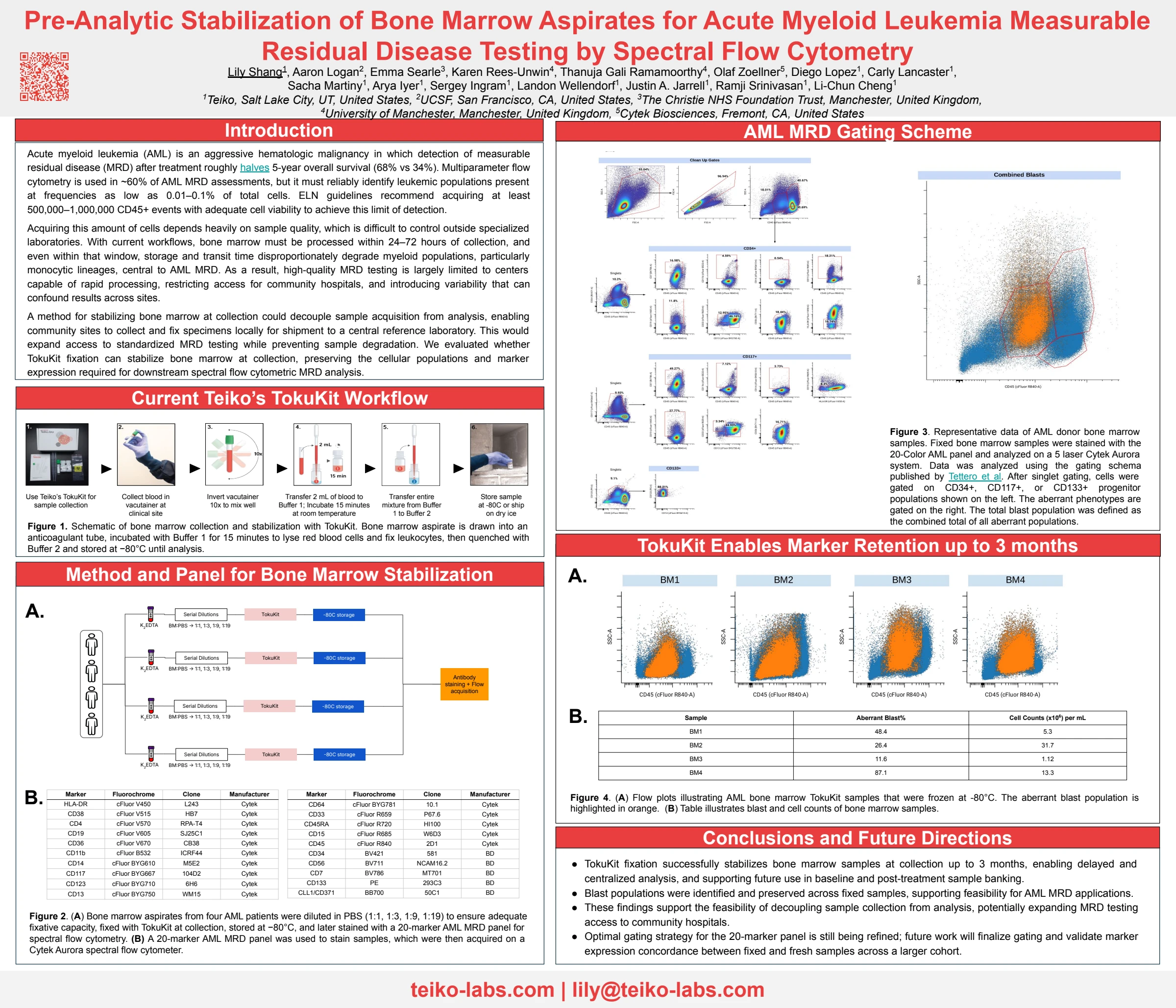
The full poster now provides preliminary feasibility results. Bone marrow aspirates from four AML patients were diluted with PBS at 1:1, 1:3, 1:9 and 1:19 to ensure adequate fixative capacity, fixed with TokuKit at collection and stored at −80 °C. The described workflow uses Buffer 1 for 15 minutes to lyse red cells and fix leukocytes, followed by quenching with Buffer 2. Samples were subsequently stained with a 20-marker AML MRD panel and acquired on a five-laser Cytek Aurora spectral cytometer.
The investigators report marker retention and bone marrow stabilization for up to three months, with representative AML blast populations and aberrant marker patterns identifiable after fixation. Their table lists aberrant blast fractions of 48.4%, 26.4%, 11.6% and 87.1% for BM1–BM4, respectively. These are substantial blast populations; they do not establish MRD sensitivity or a validated limit of detection at 0.01%. The 0.01–0.1% frequencies and event-acquisition recommendations in the introduction provide background, not a tested LoD result.
CFCM interpretation: Stabilization at collection could enable delayed centralized analysis and sample banking. The evidence remains preliminary and manufacturer-linked. Preserved detectable blasts in four specimens are a feasibility signal, not proof of equivalence to fresh marrow or a validated clinical MRD assay.
What to watch next: The authors state that the optimal gating strategy for the 20-marker panel is still being refined. Future work will finalize gating and validate marker-expression concordance between fixed and fresh samples across a larger cohort. Request paired fresh comparators, time-specific recovery and marker data, low-level MRD performance, event requirements and explicit failure criteria before adopting a clinical workflow. Source: full conference poster
#237 · Synthetic CD34+ Stem Cell Mimics
Conference Poster/Abstract · Manufacturer-Linked Evidence
Swetha Gunturu, Subhanip Biswas, Valerie Chen, Brian Kerfs, William Pratcher and Kanwal Palla · Slingshot Biosciences, Inc.
View full poster / PDF · Open full-size image
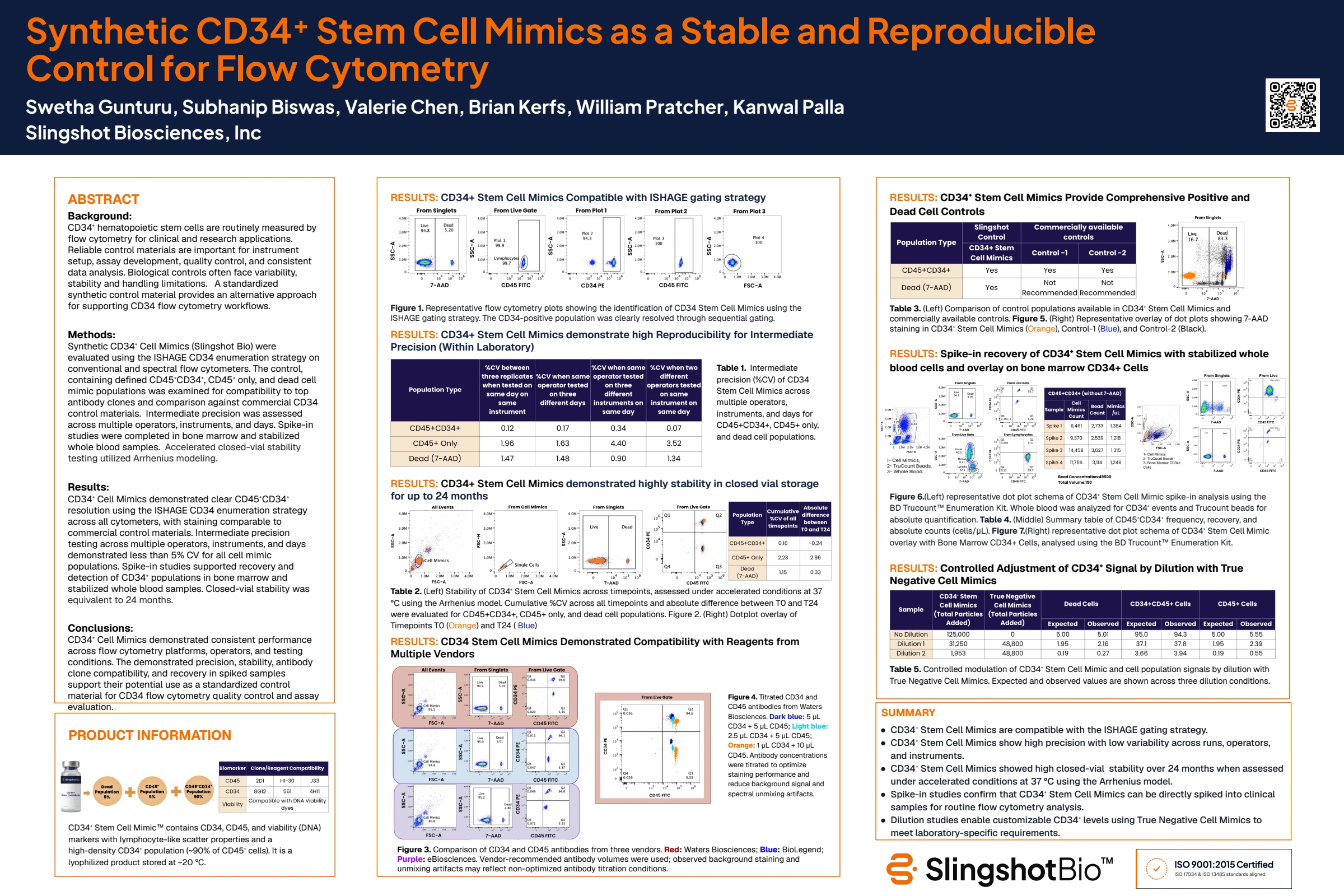
The manufacturer-authored poster evaluates synthetic controls using ISHAGE CD34 enumeration gating on conventional and spectral cytometers. The material includes defined CD45+CD34+, CD45+ only and dead-cell mimic populations. Intermediate precision was <5% CV for all mimic populations across the tested operators, instruments and days.
Spike-in studies supported recovery and detection of CD34+ populations in bone marrow and stabilized whole blood. The poster also reports multi-vendor antibody compatibility and controlled adjustment of CD34+ levels by dilution with True Negative Cell Mimics. Its reagent comparisons note that background staining and spectral unmixing artifacts may reflect non-optimized antibody titration; compatibility does not remove the need to optimize the local staining protocol.
Stability evidence: closed-vial stability equivalent to 24 months was estimated from accelerated testing at 37 °C using Arrhenius modelling. This is an accelerated-model estimate, not 24 months of real-time stability.
CFCM interpretation / what to watch next: These preliminary, manufacturer-linked results support further evaluation as a reproducible CD34 control material. Synthetic behavior and spike-in recovery do not by themselves establish full commutability with patient specimens or validate a clinical assay. Separate instrument and staining checks from biological viability and specimen-processing controls, and assess local recovery, lot transitions and low-CD34 performance. Source: full conference poster
#246 · Whole blood versus stabilized cellular QC
Conference Poster/Abstract · Manufacturer-Linked Evidence
Hannah Micek and Stephanie Wigginton · Streck
The comparison concerns stability and reproducibility of commercial material and whole blood. The right choice depends on the assay and the biological features that need monitoring.
What to watch next: Assess commutability, lot transitions and target populations. Retain appropriate biological challenges for rare phenotypes, PNH and MRD. Source
#105 · 48-marker PIP-01 transfer for global trials
Conference Poster/Abstract · Manufacturer-Linked Evidence
Sanaz Koosha and collaborators · Cerba / Ozette
The transfer of a high-dimensional immune-profiling panel makes reproducibility across sites a concrete operational question. Trial profiling is not automatically equivalent to a validated diagnostic workflow.
What to watch next: Require site-specific acceptance criteria, shipping/stability evidence and a common approach to analysis and deviations. Source
#112 · 12-color quantitative CD123 assay in AML/MDS
Conference Poster/Abstract · Manufacturer-Linked Evidence
Nithianandan Selliah and colleagues · Cerba
Quantitative antigen assessment needs its own calibration and precision framework. A positive/negative marker decision and a transferable quantitative result are different validation targets.
What to watch next: Review calibration, reportable range, low-end precision and agreement on disease-relevant populations. Source
#238 · SpectraComp particles in 12-color immunophenotyping
Conference Poster/Abstract · Manufacturer-Linked Evidence
Lorena Hidalgo and colleagues · Waters Biosciences
Particles used for compensation or unmixing should be assessed against the actual reagents and cellular spectral behavior. Convenience in control preparation does not remove the need for matrix review.
What to watch next: Examine reagent compatibility, lot stability and residual artefacts in the local panel. Source
#119 · Two-tube T-cell function panel with CAR detection
Conference Poster/Abstract · Manufacturer-Linked Evidence
Farzad Oreizy, Angela Chen, Chih-Hung Lai, Rodrigo Pestana Lopes, Yang Zeng · BD Biosciences, Milpitas, CA, USA.
Poster branded Waters Biosciences / formerly BD Biosciences.

View full poster (original PDF) · Open high-resolution poster image
Study and preparation: The two-tube 12-color Effector & Memory panel was evaluated using anti-CD19 CAR/NFAT (Luciferase) reporter Jurkat cells spiked into healthy-donor white blood cells (WBC). The BD PE CD19 CAR Detection Reagent targets the CAR construct through its CD19-binding domain and therefore cannot be used in the same staining tube as an anti-CD19 antibody. Donor WBC and CAR Jurkat cells were stained separately, washed and then combined for acquisition; 7-AAD was added before acquisition.
Assay transfer: Settings were exported from one BD FACSLyric and transferred to two additional FACSLyric instruments using the BD FACSuite assay export/transfer feature, with performance QC and assay/tube settings setup. The same-tube spiked samples were acquired across all three instruments, with a stopping criterion of 30,000 CD3+ T cells.
Reported reproducibility: MFI differences across CD3+, CD4+, CD8+, B, NK, monocyte and CAR-T populations ranged from 3.4–9.6%; differences in %Parent ranged from 0.1–3.1%. The poster reports population-frequency CVs <1.3% for lymphocyte subsets and 3.1% for monocytes. Table 2 displays 1.3% for B cells, so the tabulated B-cell value sits at that stated boundary. MFI CVs were ≤9.6% across the reported populations (Table 3).
CFCM interpretation: This is an assay-transfer/reproducibility study in spiked healthy-donor material, not clinical validation of CAR-T monitoring in patients. Same-tube acquisition supports assessment of instrument transfer under the tested conditions; it does not establish performance across patient specimens, CAR constructs, independent sample preparations or clinical decision thresholds.
Research Use Only. Not for use in diagnostic or therapeutic procedures.
What to watch next: Evaluate construct specificity, interference, independent preparation variability and low-frequency recovery in representative patient material before making a clinical monitoring claim. The separate staining workflow is an essential part of the tested method. Source: original full conference poster supplied by Yang Zeng
06 / Molecular flow
The cytometer can read molecular products as well as cells. This expands its role, but it requires a clear distinction between molecular variant allele frequency and cellular MRD percentage.

#140 · Single-RNA detection in intact cells
Conference Poster/Abstract · Manufacturer-Linked Evidence
Josefine Lustig and collaborators · Rarity / Nottingham
The superRCA application explores a molecular readout within intact cells. Its potential should be judged by target specificity and background, not by transferring mutation-assay sensitivity claims to RNA measurements.
What to watch next: Ask for RNA integrity controls, target specificity and the relationship between detected products and original molecules. Source
#141 · FMC63 CAR-T monitoring
Conference Poster/Abstract · Manufacturer-Linked Evidence
Amey Mukim and colleagues · Rarity
A construct-directed molecular assay offers a different perspective from immunophenotypic CAR-T identification. Each approach has its own denominator and biological interpretation.
What to watch next: Compare construct detection with viable CAR-T enumeration and define the meaning of residual molecular signal. Source
#213 · Ultra-sensitive mutation detection
Conference Poster/Abstract · Manufacturer-Linked Evidence
Amey Mukim and colleagues · Rarity
The broader superRCA mutation platform is an industry-linked conference signal. Analytical sensitivity must be tied to target, input quantity, background and detection rules.
What to watch next: Require independent replication and target-specific blank, detection and quantification studies. Source
#143 · KIT D816V beyond ddPCR: keep the claim assay-specific
Conference Poster/Abstract · Manufacturer-Linked Evidence
Natalia Sigal and collaborators · ARUP / Blueprint / Rarity
The conference abstract reports LoD 0.0006% VAF, LoQ 0.001%, R²=1.00 against ddPCR and detection in 10/10 indolent systemic mastocytosis samples previously undetectable by ddPCR. These are preliminary, industry-linked results, not independent external validation. This is poster #143, distinct from the multiplex #235.
What to watch next: Review DNA input, replicate precision at the low end, negative samples and cross-contamination controls. Correlation alone does not establish quantitative interchangeability. Source
#235 · Multiplex KIT D816 variants
Conference Poster/Abstract · Manufacturer-Linked Evidence
Irene Golán Cancela and colleagues · Rarity / Blueprint
Multiplex variant detection is a separate assay-development question from the single-target KIT D816V study. Do not attach the #143 detection/quantification limits or patient-series results to this multiplex assay.
What to watch next: Evaluate each variant, cross-reactivity, DNA input and per-target performance in clinical samples. Source
#205 / manufacturer-listed · Linking molecular flow to automated MRD infrastructure
Conference Poster/Abstract · Manufacturer-Linked Evidence
Tomas Edgren and Lei Chen · Rarity; related Beckman event listing
Direct-from-blood molecular flow and automation-linked workflows explore whether established cytometry infrastructure can support molecular testing. Sharing hardware does not make sample preparation, controls or reporting equivalent to cellular flow.
What to watch next: Validate the full molecular process and distinguish a manufacturer-listed automation concept from demonstrated local clinical performance. Source
Technology Watch: two signals to keep in perspective
#107 · Interacting cells in peripheral blood
Conference Poster/Abstract · Manufacturer-Linked Evidence
Chip Lomas and colleagues · Waters Biosciences
Imaging can help distinguish genuine interacting cells from coincident events or aggregates. This is a biologically interesting direction; its routine diagnostic role is not established by the title.
What to watch next: Define event identity, artefact controls and whether the observation changes a clinical interpretation. Source
Manufacturer-listed · Pulse Qualification Technology
Conference Poster/Abstract · Manufacturer-Linked Evidence · Work in Progress
Beckman Coulter Life Sciences
Public detail is insufficient for a clinical performance judgment. Retain this as Technology Watch, without inferring a mechanism, benefit or diagnostic claim.
What to watch next: Wait for a disclosed method, appropriate comparator and quantitative validation. Source
Peer-reviewed support: background, not a stamp on these posters
Peer-Reviewed Support · Published TRBC1 work supports the rationale for lineage- and maturation-aware clonality assessment, while also describing interpretive pitfalls. It does not independently validate the 2026 cytoplasmic TRBC1/2 case series, the new conjugates or a particular MRD workflow.
- Flow Cytometric Evaluation of Surface and Cytoplasmic TRBC1 Expression in the Differential Diagnosis of Immature T-Cell Proliferations (AJCP, 2022)
- Flow Cytometric Assessment of TRBC1 Expression for the Diagnosis of T-Cell Lymphoma: Clinical Utility and Pitfalls Related to T-Cell Clones of Uncertain Significance
Related practice context: ICCS module on post-immunotherapy monitoring pitfalls. This is society educational guidance, a separate evidence category from a peer-reviewed research study. No unverified poster is labelled peer-reviewed.
What ICCS 2026 is really telling us
Clinical flow is moving toward richer, more integrated information. The constraint is increasingly the quality of the chain connecting specimen, signal and interpretation. Spectral panels need sustainable references; AI needs accountable decisions; automation needs preserved biology; and molecular flow needs assay-specific controls and an honest denominator.
That is why the most useful next question is not “How many colors?” It is “Can another laboratory reproduce this result, recognize when it fails and explain what it means clinically?” Conference abstracts establish promising directions. Complete datasets, independent replication and local validation determine which directions become dependable practice.
What CFCM will be watching next
Five ICCS 2026 studies we believe deserve continued attention as full datasets, peer-reviewed publications and independent validation become available.
- #245 — 39-parameter T-ALL MRD: low-level performance and a review workflow that remains clinically manageable.
- #219 — blinded 20-color AML: full agreement analysis, discordant cases and transparent sponsorship.
- #136 — NGS-positive / flow-negative MRD: clone identity and integrated interpretation.
- #228 — FlowSimon: external prospective testing across panels, platforms and difficult cases.
- #216 — hemodilution: actionable specimen-quality assessment before interpreting discordant blast estimates.
Sources, provenance and image rights
Prepared on 6 October 2026 from the CFCM editorial research inventory, checked against the official ICCS program and public conference abstracts. Entries distinguish preliminary reports from CFCM follow-up questions; no results are inferred from a title alone. Manufacturer-only listings remain explicitly identified, and incomplete projects retain Work in Progress status.
- Official ICCS 2026 program and poster numbers
- Official conference abstracts — search each title on the page
- Waters Biosciences ICCS poster listing — manufacturer source
- Beckman Coulter ICCS event and technology listing — manufacturer source
The remaining original CFCM explanatory graphics are schematic illustrations, not patient data. Poster #216 is reproduced from the original PowerPoint file shared by Ntasha Roy for the requested educational publication on CFCM, with credit to Roy et al. and participating institutions. Its full-poster PDF was exported from that file; the block was updated on 8 October 2026 and retains Conference Poster/Abstract status. Poster #237 is reproduced from the original PDF supplied by Swetha Pratyusha Gunturu, with explicit permission for educational reproduction on CFCM and credit to the authors and Slingshot Biosciences, Inc. The #237 block and its source were updated on 8 October 2026. Poster #218 is reproduced from the full PDF shared directly by presenting author Lily Shang in response to CFCM’s poster request, with credit to Lily Shang, co-authors and their institutions; its block was also updated on 8 October 2026. Both remain preliminary, manufacturer-linked conference evidence.
Poster #119 was updated on 8 October 2026 from the original PDF shared directly by Yang Zeng in response to CFCM’s poster request. Credit: Farzad Oreizy, Angela Chen, Chih-Hung Lai, Rodrigo Pestana Lopes and Yang Zeng; BD Biosciences, Milpitas, CA, USA. The poster carries Waters Biosciences / formerly BD Biosciences branding and remains Conference Poster/Abstract · Manufacturer-Linked Evidence, with the stated Research Use Only restriction.