Paper into Practice
Clinical Flow
Functional immune testing: EdU, DHR-123 and adhesion deficiency
EdU, DHR-123 and adhesion-deficiency assays illustrate why function cannot be inferred from cell counts.
A report of normal lymphocyte and neutrophil counts cannot establish normal immune-cell function. This newly published laboratory protocol groups three complementary clinical flow cytometry assays—EdU incorporation, oxidative burst with DHR-123, and leukocyte adhesion deficiency evaluation—where the question is not simply how many cells are present, but how they respond to a defined challenge.
What the protocol actually covers
The authors organise clinical functional cytometry around three assay families: EdU-based lymphocyte proliferation, DHR-123 neutrophil oxidative burst, and leukocyte adhesion deficiency evaluation. These address biological performance of immune cells, not simply the abundance of CD-defined lineages. A normal lymphocyte-subset count does not demonstrate normal proliferation; a neutrophil count cannot exclude an NADPH oxidase defect.
Methodological value
In functional testing the paired control and stimulus are part of the measured result. For proliferation, the central question is change in EdU incorporation relative to validated negative and positive controls. For DHR-123, the laboratory examines the fluorescence shift after appropriate stimulation and compares it with internal and external controls; sample freshness, reagent handling, granulocyte gating and known atypical patterns matter. For adhesion-deficiency panels, method-specific antigen patterns must be interpreted with phenotype and genetic findings.
DHR-123: an instructive example of why the controls matter
In the oxidative-burst assay, neutrophils are measured in unstimulated and stimulated conditions, with appropriately processed control blood. The analytical observation is a change in fluorescence distribution after stimulation, not a stand-alone absolute intensity. The interpretation also depends on granulocyte identification, instrument settings, reagent integrity, sample handling and timing.
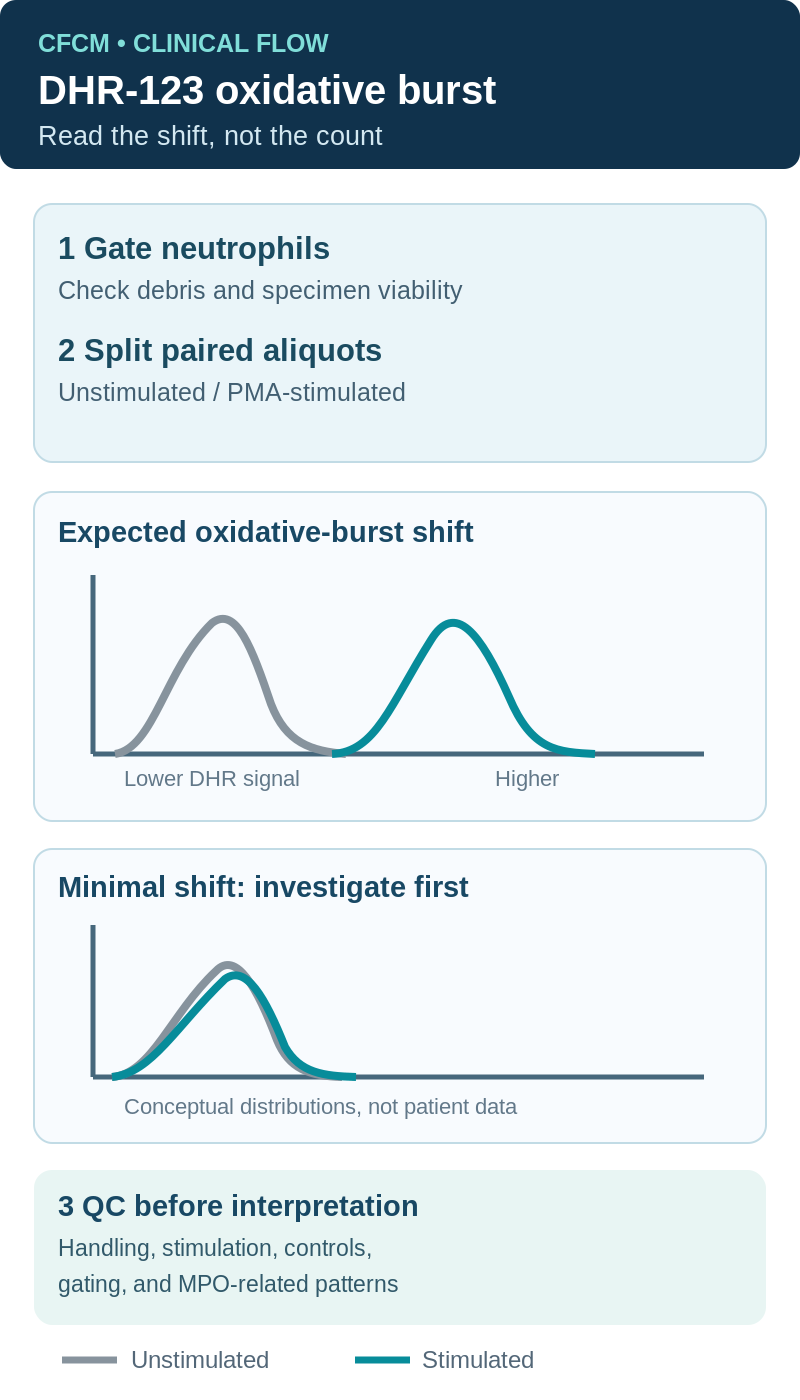
An absent or small stimulated shift is not, by itself, a diagnosis of chronic granulomatous disease. Follow the laboratory's validated algorithm, assess technical failures and relevant alternative causes (including myeloperoxidase-related DHR patterns), and arrange appropriate specialist and genetic assessment where indicated. Carriers and partially affected populations may also produce more complex distributions than a single peak.
Clinical decisions and validation questions
For lymphocyte proliferation, establish a defensible denominator and matched stimulated/unstimulated comparisons before interpreting EdU incorporation. For DHR-123, define control acceptance, stimulus, time from collection, granulocyte gating, shifts or indices used and criteria for non-reportable samples. For leukocyte adhesion deficiency, differentiate expression measurements from functional performance and integrate the laboratory pattern with clinical findings and molecular work-up.
Before adopting a published protocol, the laboratory must verify or validate its intended use on its instruments and specimens, including precision near relevant decision points, analytical interference, age-appropriate controls where applicable, specimen stability, positive/negative control processes and reporting limitations. The protocol provides a technique; clinical decision limits require evidence and local implementation checks.
Evidence boundary
This is a published laboratory protocol, not a prospective diagnostic accuracy trial, and it does not establish universal cutoffs across instruments or patient populations. Laboratories adopting it must verify specimen conditions, stimulation time, precision, reference intervals/decision limits, failure recognition and reporting format for their intended use.
Daily Learning Pill — function is not a marker count
Surface phenotype answers which cells are present; stimulated function asks what the cells can do under a defined perturbation. This is why control design and the relation between baseline and stimulated response are critical to interpretation. Academy reuse: Clinical Immunology / Functional flow assays / DHR and proliferation.