Analysis
AI & Data
FlowKit Workspace Exchange: Compare Event Membership, Not Just Counts
The original 2021 FlowKit paper connects Python analysis and FlowJo workspaces. A local exchange check should preserve compensation, transformations and event identity.
A matching percentage can hide different cells
Imagine two analyses that both report one hundred events in a population. The agreement in count does not establish that they selected the same one hundred events. For a software exchange exercise, the question is what survived the transfer, including the event identities and the operations that produced membership.
What the original FlowKit paper demonstrates
White and colleagues' 2021 Frontiers in Immunology article presents a Python toolkit for integrated manual and automated cytometry workflows. Sample, GatingStrategy and Session objects organise data and analysis. The paper describes compensation, transformations, hierarchical gates and exchange of FCS files and FlowJo workspaces, with examples of returning programmatically constructed analyses to FlowJo.
The publication explicitly describes limited support for FlowJo 10 workspaces. Its software comparison and supported runtime versions belong to that publication period. They should not be presented as a current compatibility matrix or as validation of every workspace feature.
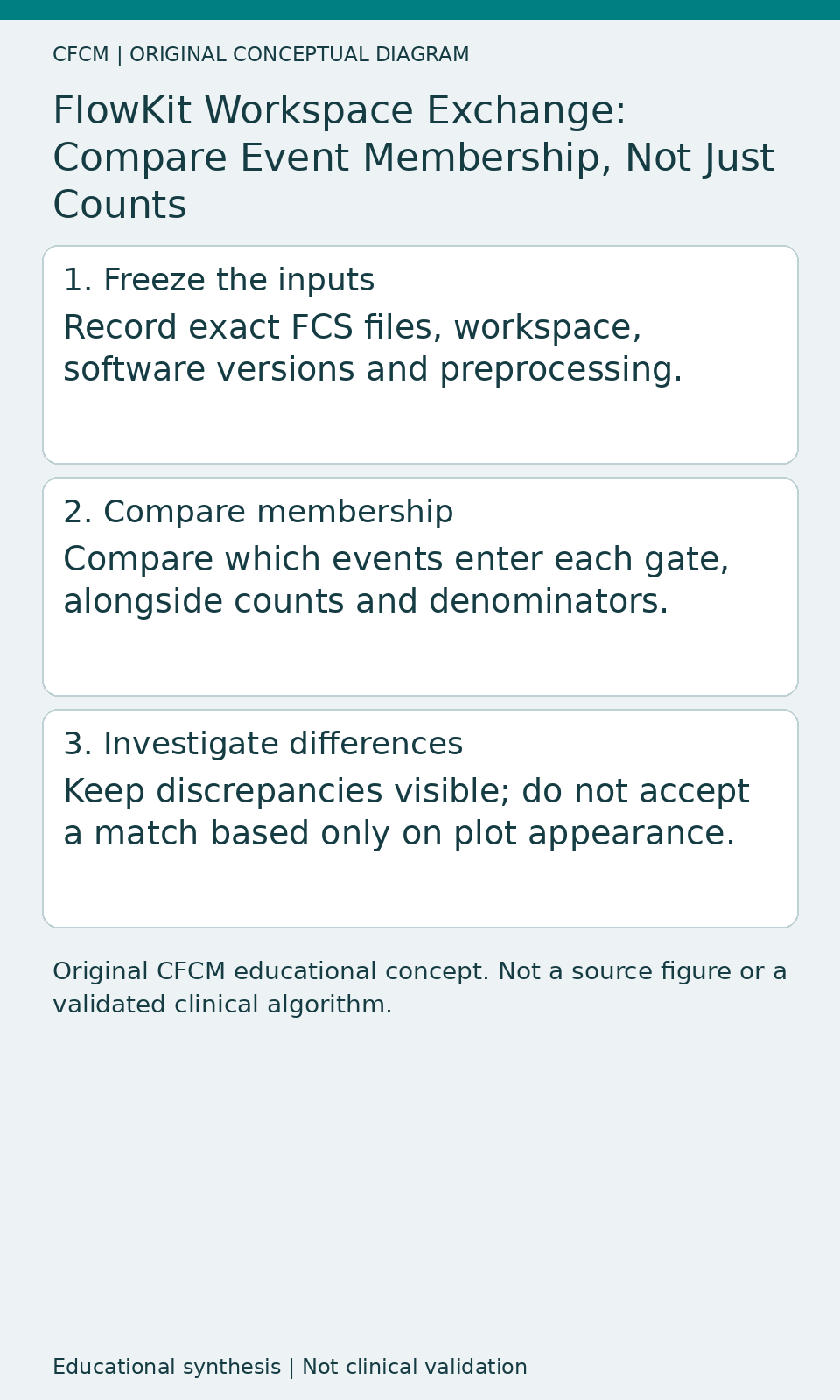
Define a bounded exchange test
Start with an exact, archived workspace and its corresponding acquisition files. Record the versions used in both applications and identify a small set of populations whose membership can be compared. Include a population affected by a transformation and a downstream gate whose denominator depends on its parent.
Before comparing outputs, check whether the data entering the second application are raw, compensated or transformed. Applying an operation twice is a different failure from omitting it. Keep a record of the actual matrix and transformation parameters rather than inferring them from an axis label.
Compare the discrepancy, then decide
Compare total events, parent and child counts, and event membership where identifiers remain traceable. A useful discrepancy record identifies events selected by one workflow but not the other. Inspect their location relative to the relevant boundary and document whether the explanation concerns numerical precision, a setting, a feature or an unresolved difference.
This is a proposed local verification approach. No software was executed or benchmarked for this article, and no numerical tolerance is claimed to be universally acceptable. Set acceptance criteria according to the intended use before reviewing the answer. A successful limited exchange does not establish diagnostic performance for a clinical panel.
Daily Learning Pill
A workspace that opens successfully has passed a file-reading step. Confirm the analysis meaning with evidence from the events and settings.
Explore CFCM tools and troubleshooting. Original ChatGPT/Codex educational analysis, not independent scientific review or clinical certification.