Analysis
Validation & QC
CytoNorm: Check the Reference Range Before Correcting a Batch
Shared controls can support normalization, but the original CytoNorm study shows why control coverage and a held-out check matter before trusting aligned plots.
Alignment is a question, not the endpoint
A clean overlay is an attractive result in a longitudinal cytometry study. Before celebrating it, ask what information permitted the adjustment and what observation could reveal a wrong correction. A normalization record should make those questions answerable without relying on the final visualization alone.
What the primary study tested
Van Gassen and colleagues describe CytoNorm in Cytometry Part A, first published online in 2019 and included in the 2020 volume. Their method learns batch transformations from shared reference controls. It clusters cells and fits population-specific quantile transformations using splines, then applies the learned transformations to other samples in the batch.
The principal evaluation used mass cytometry data from a pregnancy study. A second donor provided validation samples distinct from the donor used to learn transformations. Distribution alignment was evaluated using Earth Mover's Distance. The authors also tested mismatched stimulation coverage: reference samples lacking the relevant expression range could produce erroneous extrapolation. They caution that severe batch effects can themselves disrupt clustering.
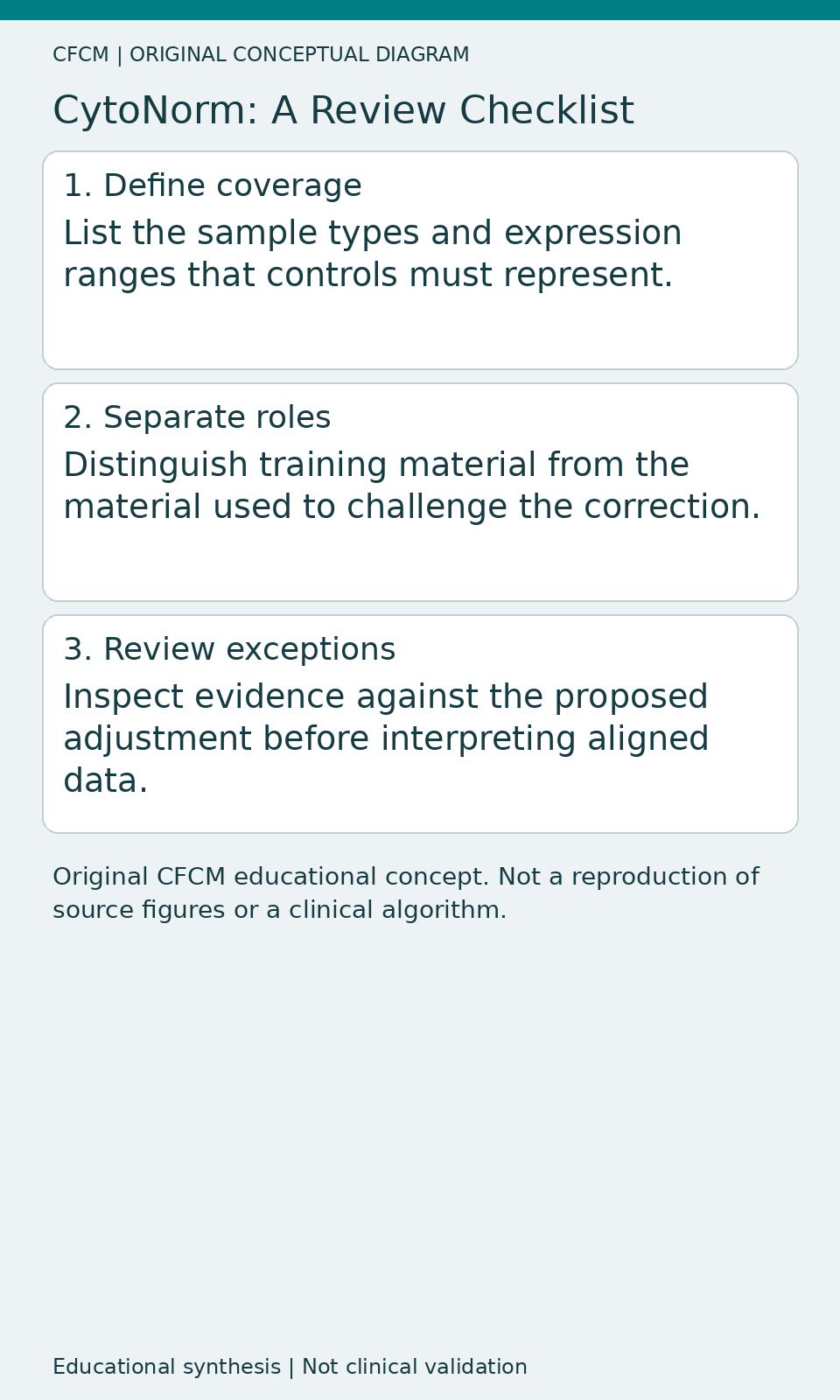
A review record that can disagree with the plot
For a new project, write down the intended use before choosing a correction. Which sample types and expression ranges must the control represent? Which material will remain outside model fitting? What result on that material would make the team reject the correction? These questions turn a visually pleasing output into a testable analysis proposal.
Keep the input files, batch labels, transformation settings and output files together in the analysis record. Mark the role of every control explicitly. A reader should be able to distinguish material used to learn a mapping from material used to challenge it. If the same specimen fills both roles, describe that limitation rather than calling it a held-out validation.
What this does not establish
The paper's principal experiments concern mass cytometry; its discussion of possible fluorescence applications is not a local validation of every fluorescence panel. This technical review does not authorize importing its settings into a clinical assay. Any proposed application needs evidence appropriate to that laboratory's materials and intended decisions.
Daily Learning Pill
Ask what the reference did not show the model. Missing expression ranges belong in the review discussion before the corrected data are interpreted.
Use the CFCM resources to structure your next cytometry methods meeting. Educational analysis by ChatGPT/Codex; not independent scientific review or clinical validation.